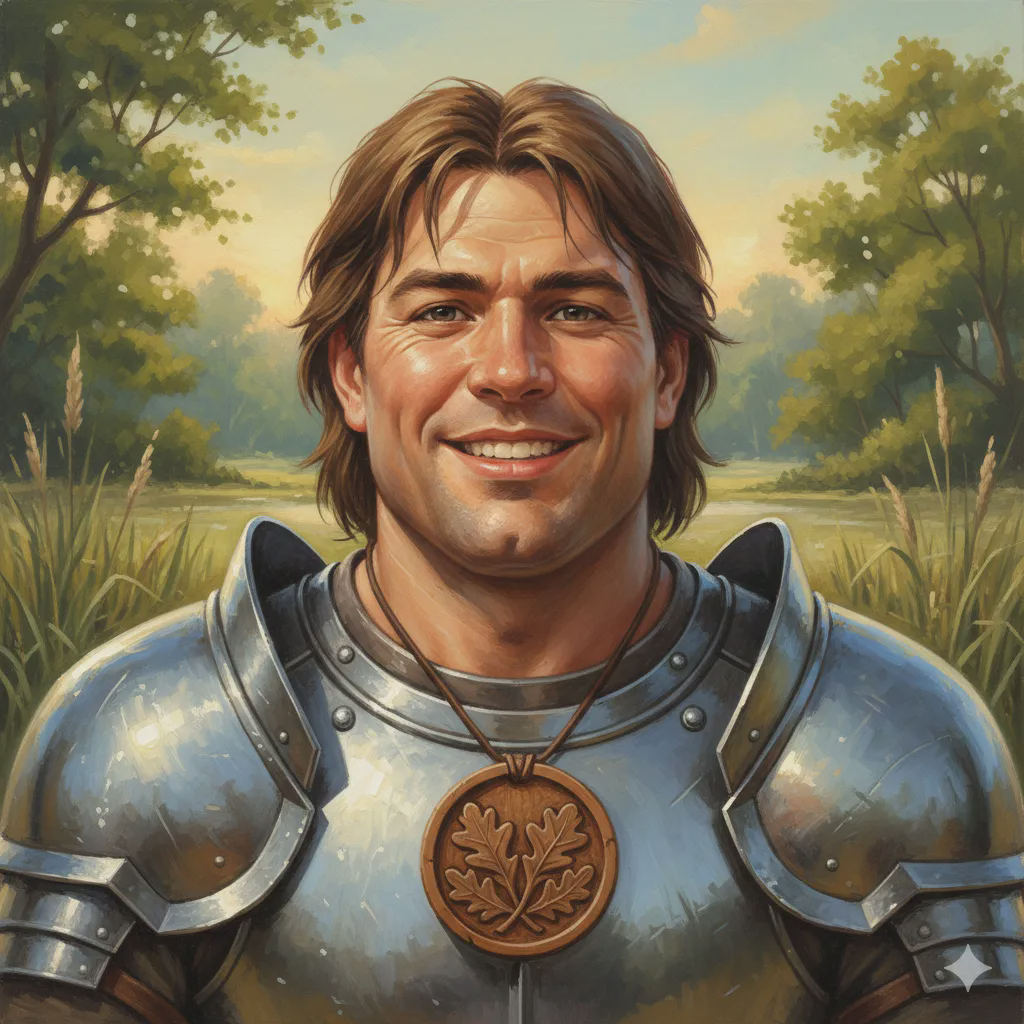
Hired Hands
A hired hand is not a friend and is not family, and every farmer who has ever taken one on knows the arithmetic of it, even if he does not know the word. You pay him by the day. You feed him. If he is any good you keep him through harvest and if he is not you do not, and when he leaves he takes his wages and you take your crop and neither of you owes the other an explanation. There is no cruelty in it. It is the only arrangement that works, because a farm that cannot let a man go is a farm that goes under with him.
Bancroft hired four of them on Thursday morning. By nightfall all four were dead and he had twenty-five gold in gem chips to show for it, and he has been trying since to make the arithmetic come out.
The silver river
He was dead first, which ought to be said plainly.
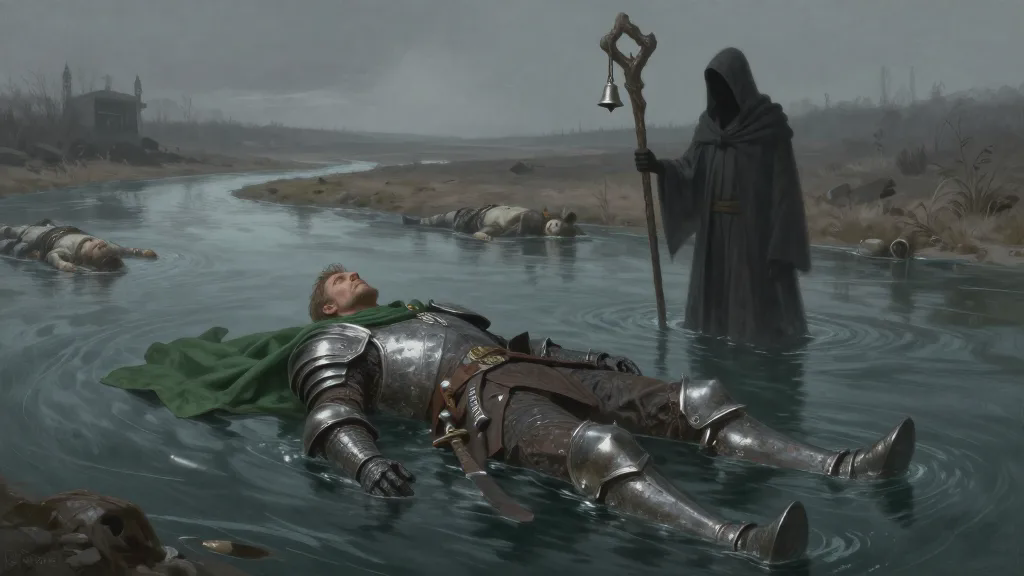
He does not remember the hall or the retreat or any of what the others tell him happened after. What he remembers is water. He was on his back in a river the colour of a knife, moving, and his arms and legs were dead weight, and there were other bodies going down the current alongside him with their faces up the way his was. There was a grey plain off past the bank with nothing on it at all. Not a tree, not a fence line, not so much as a rise. He had a long look at it. A man who has spent his life reading ground can tell you a great deal about a country from one look, and what that country said was that nothing had ever grown there and nothing was going to.
He tried to turn over. It cost him everything he had, and the river turned him back, patiently, the way water rights a boat -- and that was the worst of it, that floating was the natural position and fighting it was the effort. There was a man near him he thought he recognised. It was not who he thought. The eyes were gone and whoever it had been was not in there any more.
Then something tapped him on the shoulder three times with a staff, and there were little bells on the staff, and they made a sound like harness in a cold morning.
He never saw a face. A cloak, and inside the hood a hole with nothing in it, and a few white hairs coming out of the neck of it, and hands that were old the way a root is old. It looked him over and said that this one was still lively, and asked what he hoped to gain.
He told it the truth, because he could not think of a lie worth the effort. He said he wanted to go back to growing things. He said he used to be a farmer and then he made a decision to change careers.
It said: maybe unwise.
Then it said it had seen him before -- and he has thought about that since, more than about anything else it said -- and that his was a compelling argument and his will was strong, and let us see what happens. And it hit him over the head with the staff and the bells went and he was back in his body in the dark, in the dirt, with barely enough left in him to breathe and a year of his life gone out of him.1
The bruises came up on his neck within the hour and they have not gone down. They are the shape of a hand. Nothing choked him, so far as anyone can say. He wears a scarf now.2
Plump girl was plump
The mongrelmen came for him in the dark and he let them.
He could not walk. The choice on offer was to crawl back through a hall he had watched fill up with the dead, or to lie still and let the neighbours take him in, and he was not in a state to be proud about it. So he lay there and heard the small voices working out whether he might still be delicious, and told them he was not, and they took him at his word and carried him home. They bore him no ill will. They have never borne him any ill will. That is somehow not the comfort it ought to be.
On the way one of them said, conversationally, that the plump girl was plump. Thank you.
He did not answer that either.
They set him down at the foot of the rope with a blood trail behind him a good way back up the passage, looked up at the torchlight, put their hands over their eyes, and left. Anister dropped the ladder on his head. He got up it somehow, and lay on his back at the top with the sky over him, and found that it was very restful being on his back, which frightened him more than the fall would have.
He prayed for healing there and got a thin green flicker and nothing else. He tried again and got less.3
Fifteen gold
They went back to Helix with a tarnished bowl.
It cleaned up gold. Fifteen for the bowl, split three ways, five apiece -- and a double handful of polished pebbles that are worth nothing to anyone over the age of five. Bancroft took four of them anyway and wrote them down as four of the prettiest, shiniest rocks, and he means to leave them at the mongrelmen's door the next time he is down there. They did him a good turn. They like shiny rocks. It costs him four slots and no money at all, and it is the only debt from that whole night he has any idea how to settle.4
Anister wanted to know why he had run off into the middle of the dungeon when the rest of them were running out. He said that if he had followed them the whole pack would have come along behind and they would have been caught between two groups and all died. That is true and he believes it. Anister said they had got out anyway.
Nobody said Irulan's name. There is a new woman with them now, a wizard called Nimue, and she is wearing Irulan's cloak, and nobody has said that either.
They caroused that night, all three of them, ten gold apiece to stand in the Brazen Strumpet and tell the story of how they nearly all died. It is a real story and it went over like a wet sack. Bancroft showed the neck. People said ooh. And in the morning they woke up not hungover, not richer, not wiser, having learned exactly nothing, which the innkeeper's ledger will tell you cost them thirty gold between them.5
Bolo looked up from the bar and said the three of them looked depressed, and that when he was down in the dumps he went and prayed at St. Yiggs, and it made him feel better.
Somebody -- Bancroft is fairly sure it was the god, working through a man wiping a counter -- was making a point.
What money is for
He said out loud that morning that he liked the idea of the farm.
The reply came back before he had finished the sentence: so therefore you need money, and how do you get money? Not by going into the Barrowmaze, apparently.
There were two old adventurers in the room who looked at his neck and said they had been there, and showed him what they had, and told him about a shoulder that does not work any more. He is not sure whether that was meant as a warning or a welcome. It rained all morning. By noon it was storming properly, wind in the leaves and thunder over the barrows, and they walked out into it because a man who wants to buy a farm needs money and this is the only trade he has.
There were no torchbearers to be had. What there was, was two men-at-arms and their dogs.
Bilbar was a halfling with a sling, a codpiece, and hair he had put considerable work into, who rode a war dog named Chick Magnet and made his living, to hear him tell it, on the strength of that arrangement. He was two feet tall and entirely convinced. Tarford was a human with a club, a dagger, no armour, a skull on a thong round his neck, and nothing whatever to say for himself except that he was proficient in several weapons and that his dog was called Mutt and would fetch. Three gold a day for each pair, dogs included, and Bancroft paid half of it and Anister the other half.6
They gave Tarford Irulan's chainmail and her shield and a light crossbow. It seemed sensible at the time. The man had come to them with a club.
Bilbar they asked to carry a torch, politely and at some length, and he declined on the grounds that torchbearers do not get chicks, and men-at-arms do.7
Bancroft put a Light on his shield and it took beautifully, the best casting he has managed in weeks, and down they went.8
The thing that would not stay dead
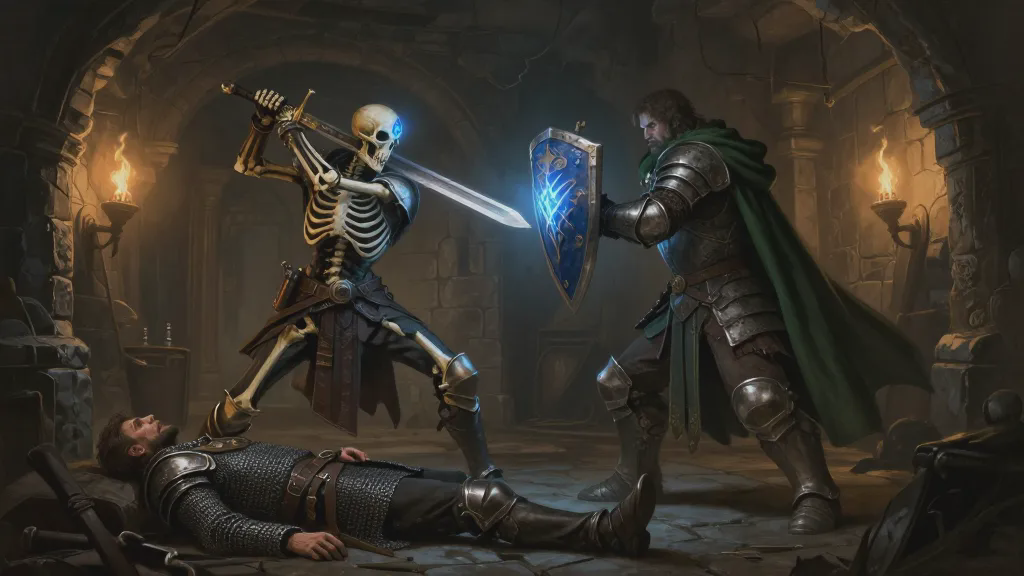
It came around the corner in the first minute, clack of bone on stone, with a sapphire set in its forehead where a thought should be.
They were surprised. It did not care who it hit -- it goes to noise, that is all it does -- and what it went to was Tarford, who had been in their employ about four hours and was wearing a dead woman's armour, and it opened him up with a longsword before anyone could get to him. He had said almost nothing all morning and he said nothing at the end either.9
Mutt started barking and would not stop. Anister got down beside him and told him that now was not the time and that they would avenge his master, and the dog believed him, and quieted.
Bilbar took one look at it and ran. He is entitled to. A hired man is allowed to decide the day is not worth the wage, and he decided it honestly, and he went off into the dark with his dog under him and no light of any kind.10
Then the rest of it, which took an hour and which Bancroft will be some time getting over.
You hit the skeleton until it comes apart. It comes apart properly -- goes to dust in front of you, and the gem drops on the stone. Then, unless somebody breaks the gem in the moment it is lying there, it lifts up to about the height of a man's head and the whole thing builds itself back around it and comes on again, at full strength, as though you had done nothing.
They did it four times. Four times they put it down and four times it stood back up, and each time it cost them arrows and blood and prayers and torches -- the torches kept going out, three separate times, which by the third had stopped being funny.
Nimue's spell failed her worse than he has ever seen a spell fail anyone, and while it was going wrong something was crawling around her left hand that had segments and a mouth, and it was going to bite her, and she shook it off and the spell went through as though nothing had happened. She has not mentioned it since. Bancroft has not asked.11
He tried to set his sword alight and Silvanus declined, twice.
What finally worked was Anister thinking it through out loud: the man who knocks the thing down has used up his own blow doing it, so he cannot be the one to break the gem, so two of them have to be standing there with their swings held and waiting when it falls. Nobody attacks until he hits it. He hits it, it drops, and both of them come down on the gem in the same breath before it can rise.12
Before that could be set up, Bancroft called on Silvanus to drive it off, and the god came -- he felt the dark of that place lean on the prayer and the light come through it anyway -- and the thing turned and ran, and gave them the little while they needed to get organised.13
Then Anister put an arrow through it, and it went down, and Bancroft swung at the gem and missed by a mile. Anister told him to try it again, and put something of his own behind the words. Bancroft swung again -- and Anister caught his elbow and turned the swing -- and the sapphire went to pieces on the floor and lay there gleaming in the torchlight, and it was over.14
Twenty-five gold in shards. Ten minutes on his knees picking them out of the dirt.15
The room at the end
He healed Anister, who needed it, and they went through Tarford's pockets.
There is a decency about this that they hold to with their own dead, but a hired man is a hired man. Chainmail, shield, sling, dagger, club, and the skull on its thong. Bancroft took the skull necklace and means to put it in the ground somewhere it will be quiet. Three quarters of what they took off the man was what they had given him that morning, and he would rather not have had to notice it.
Nimue said there was nothing out there. Not that she couldn't see anything -- that there was a nothing, a large one, and it was getting closer. He has heard that said once before, a long time ago, and it went very badly, and he said out loud that they needed to get out.
They went east instead, following dog prints, because Bilbar was still owed the courtesy of being looked for.
They found him about two hundred feet on. He and Chick Magnet had come to a door in pitch darkness and opened it, and a crossbow on the north wall that had been waiting there long enough to rust went off true, and it caught both of them, and that was that.16 He had been paid for one day. He never got to spend it.
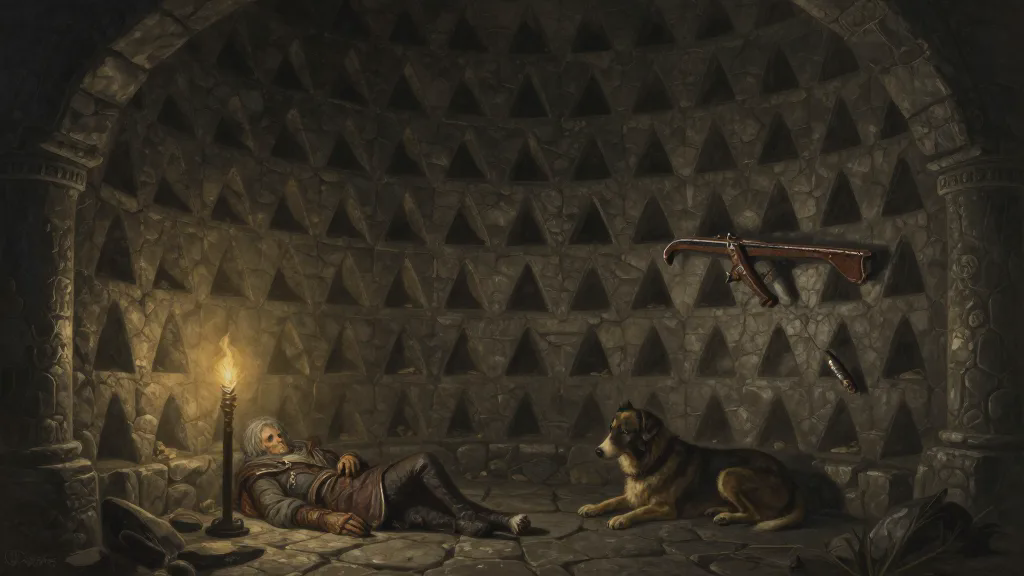
Beyond the door was a room they had never once been in, in a dungeon they have been dying in for months: alcoves cut in triangles, fifty or a hundred of them, stacked up the walls twenty feet. Two or three pulled open and searched in a hurry by somebody who did not finish the job and did not come back.17
Nobody went in. They shut the door and left it for next week.
They came out of it knowing more than they went in with, which is more than they usually manage and is not enough for anything. Twenty-five gold in sapphire chips, less thirty gold of carousing, less six gold of wages, less a lantern and a flask of oil and four torches. Four graves nobody will dig.
He wanted to go back to growing things. He said so to the thing in the river and he meant it, and the thing said maybe unwise, and then let him go anyway to find out.
-
The session opens on the roll deferred from last week. Bancroft is unconscious at 0 HP and needs a Constitution check of 12 or higher at -1 to survive; the first roll is a 3, he spends a normal luck point, and it comes back 12 -- exactly the number required. The GM's line is "by the hair of your chinny chin chin." The afterlife scene is played out privately. He gains 1 XP and permanently loses one point of Constitution, dropping him to 8. The figure with the belled staff is not named or explained; it says it has seen him before. ↩︎
-
His third scar, rolled and then chosen by the GM to suit the injury: permanent purple choke bruises across the throat, sitting alongside the two vampire puncture wounds already there. The GM's summary: "your neck is not having a good time." Bancroft's existing collection runs to a dent in the skull, pockmarks from mould, and now this. ↩︎
-
Cure Wounds at the top of the rope: the first roll is a 4 (fumble), the second gets there, and the GM narrates Silvanus answering "barely." A second attempt to top himself off produces a green flicker and no healing at all -- "I'm going to take that as just not going to work right now." The prayer is Bancroft's: "Silvanus, I have once more come back to life through your grace... though I am starting to think a farm might be a better choice," answered with "yes, you should probably be a farmer, as your Cure Wounds is not long for the world." ↩︎
-
The tarnished bowl Anister traded eight iron spikes for last session, finally opened. It is solid gold, worth 15gp, split three ways for 5gp each and 1 XP apiece. The shiny rocks in it are worthless beach pebbles. Bancroft takes four -- the carry limit before they cost him -- specifically to leave at the mongrelmen's door: "let's keep them on our good side, because they kind of did Bancroft a solid." Clarisse's share is deferred rather than set aside, on the grounds that she is dead and may not be coming back. ↩︎
-
Carousing costs 10gp for a night at +0, or 25gp for a day and night. All three pay for the night and all three roll a d8 on the carousing table. Every one of them gets the same result: the worst entry, 1 XP and nothing else. The GM's narration has Bancroft displaying the neck scars to appreciative noises and the evening amounting to nothing. In-world the date advances to Thursday the 25th of May, and the weather roll comes up storm. ↩︎
-
No torchbearers are available in Helix at all -- the roll produces two men-at-arms with war dogs. Bilbar (halfling, sling, war dog Chick Magnet) and Tarford (human, club and dagger, no armour, dog Mutt), 3gp per day per man-dog pair, hired retroactively to the previous evening because the GM allows the party to backtrack the decision. Bancroft and Anister split the six gold. The party then equips Tarford out of Irulan's estate: chainmail, shield, and a light crossbow -- the crossbow is reassigned to Bilbar before they descend, on the theory that a sling can be used one-handed alongside a shield. ↩︎
-
Anister's Charisma check to get Bilbar carrying a torch comes up 3. The refusal, verbatim: "That smells dangerously like torchbearer work. I will have none of it. I, with my sling and my chick magnet dog, will impress any woman that looks upon me. Torchbearers don't get chicks. Men-at-arms do." Nimue ends up carrying the first torch and Bancroft lights the second. ↩︎
-
Light, cast on his shield, comes up 23 -- a critical success, an hour's duration. He casts it a second time near the end of the session and crits again on a 23. The shield surviving last session intact is remarked on at the table, since the Light was on it and a smashed shield would have taken the light with it. ↩︎
-
The sapphire skeleton gets a surprise round. The GM rolls d8 for a random target -- Bilbar was a 3, Chick Magnet a 5, Anister a 7, and the skeleton stabbing itself was an 8 -- and gets a 6, Tarford. The sword hits for exactly his hit points. He is dead in the first round of his first fight, in armour the party gave him that morning, with the GM's aside: "Tarford's like, why me? There's a dumb lecherous halfling over there." ↩︎
-
With a hireling down, the GM calls a morale check for Bilbar. He fails and flees with Chick Magnet under him, into an unlit passage, which is what kills them both roughly forty minutes later. Anister's send-off: "Take your cut. Peace be with you." ↩︎
-
Magic Missile with advantage: Nimue rolls 2, 2, 1 -- a critical failure and, as the table notes, three ones in a row. She spends a luck token to convert it and the reroll comes back 19, 21, 4, 3 -- a critical success. The GM narrates the fumble as a segmented worm crawling around her casting hand and rearing to bite before she shakes it off, at which point the spell "resets" and goes off cleanly for 1 point. The worm is never explained. Her second crit later in the fight doubles to two missiles for 4 damage, which cracks the gem without breaking it. ↩︎
-
The mechanical trap of the fight, worked out by Anister at the table: the skeleton reforms on its own turn unless the gem is destroyed first, and the character who drops the skeleton has spent his action doing it. The gem needs at least 5 damage -- they establish by experiment that 4 is not enough. The solution is for Bancroft and Nimue to hold actions while Anister shoots, so that when his arrow drops the skeleton both held actions land on the gem before its turn arrives. Anister's summary: "otherwise it's an infinite skeleton." ↩︎
-
Turn Undead at 19 against the skeleton's Charisma check of 16. It flees for five rounds -- the first time the spell has worked for him in this dungeon in weeks, and the thing that buys the party the time to set the plan up. The prayer: "Silvanus, drive this undead forth. Turn it to dust. From dust he came, to dust he shall return." The GM narrates the dark of the Barrowmaze pushing back against it and the light coming through anyway. ↩︎
-
Anister's longbow at 23 drops the skeleton. Bancroft's swing at the gem misses badly; Anister offers his golden luck token unprompted, and the reroll comes back 19, enough. The GM narrates Anister physically catching Bancroft's elbow and redirecting the swing -- the mechanical assist rendered as a literal one. The party had used the identical trick against these skeletons once before, with an orc named Shacknub, and spent several minutes trying to remember whether it had actually worked. ↩︎
-
The sapphire shatters for 25gp in shards and 1 XP apiece, bringing the day's total to three experience -- unusually good for this table. Collecting them costs 10 minutes of dungeon time, which runs out Nimue's Mage Armor and Bancroft's Shield of Faith. ↩︎
-
Anister tracks the dog rather than the halfling -- Bilbar was riding, so there are no halfling prints to follow -- and the trail leads east to a door. The GM rolls the trap's attack at disadvantage because they were in the dark and crits anyway. Both Bilbar and Chick Magnet are killed outright by a single rusty crossbow mounted on the north wall, triggered by a tripwire on the door. The party had never been down that passage. ↩︎
-
The room beyond: 50 to 100 triangular barrow alcoves stacked roughly twenty feet up the walls, two or three pulled open and searched hastily by someone who did not finish. The GM calls the session before anyone can search it -- "I don't want to get into a new thing" -- and the party settles for closing the door. Anister's assessment, which is also the party's standing problem: "it would be a great place to have a thief." ↩︎