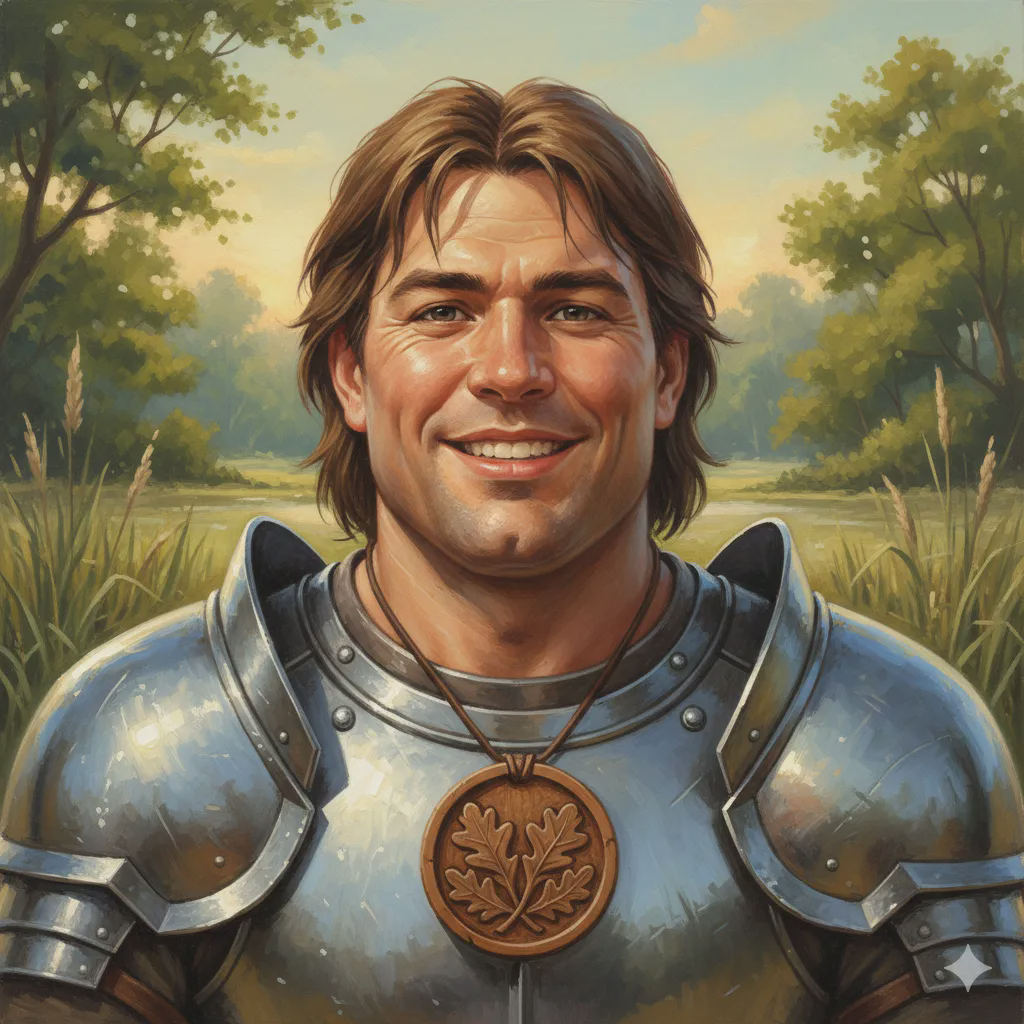
Session 63
He had knelt down in the ashes the night before with nothing in him but the sorry, and the god had not answered, and he had stayed on his knees anyway because that is what you do when you have done a thing you cannot undo. You do not get up until you are told to. Bancroft knelt in the burnt room with the smell of cooked silk in his nose and the charred man on the slab in front of him, and he waited, and after a while the green came up out of the dark behind his eyes the way it does, slow, like the first blade of a thing pushing through frost.
What came was not forgiveness. It was a knowing. The man on the slab had a name -- Hildrys Forest Green -- and he had been the last priest of Sylvanus in this country before the purging, before Saint Ygg's people drove the green god out of Helix and tore down every statue and burned every windmill and salted the faith into the ground. Someone had buried Hildrys here, wrapped head to foot in spider silk, in the dark, where no one would think to look for a holy man. And in his dead hands he held a mace with the face of the Green Man cut into its head, ivy spilling off it like rays off a sun, and the god gave Bancroft to understand, without any words, that the mace was meant for him.
He did not feel chosen. He felt the way a hired man feels when the foreman points at the heaviest sack and walks off. The penance still stood -- twenty gold in good works, paid out to people who needed it, before his god would weigh easy on him again. The vision did not lift that. It only added to the load.
So he finished the prayer the only way he knew, which was plainly. I made a grave error. He said it into the smoke. The last priest of Sylvanus, and I burned the man's grave down around him. If you want me to carry this thing out of the ground, I will carry it. If you'd sooner I find him a better bed and leave it, I'll do that, and not lay a hand on it. I won't claim what I'm not fit to claim. And then, because a man has to decide something, he reached out and took the mace.
The voice that came was not the god's. It was thin and dusty and delighted, and it spoke right into the middle of his head as his fingers closed on the haft. Oh -- finally. Someone answers my call.
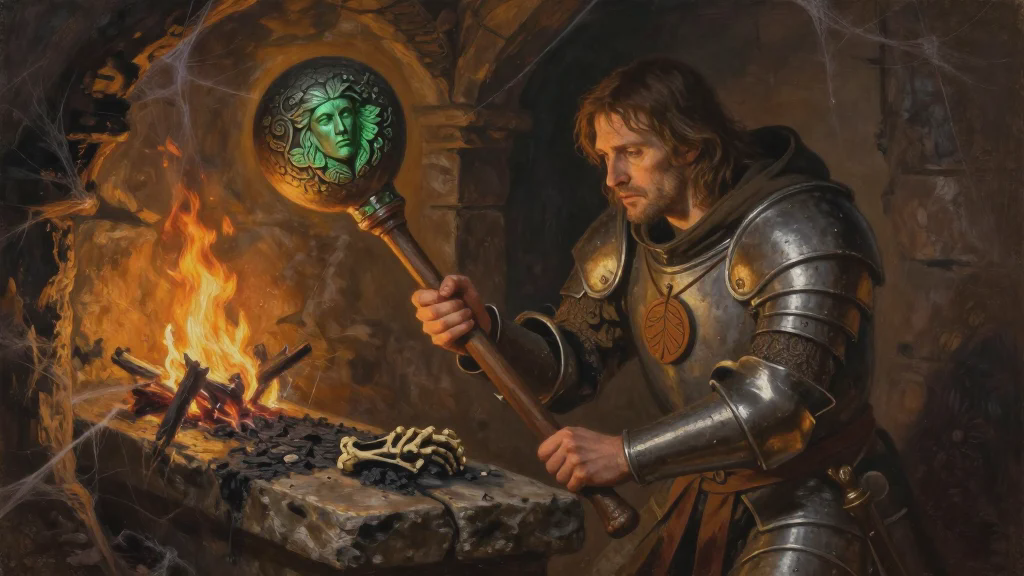
Hildrys Forest Green was not all the way gone. Whatever the purging had done to him, some part of the man had gone down into the mace instead of into the dark, and it had lain there in the webs longer than anyone in the party had been alive, waiting for a hand of the right kind to close on it. The first thing it wanted to know was whether Saint Ygg had been driven back, whether the black forest had swallowed Helix whole again. The answers Bancroft had were not the ones it wanted. The priests of Sylvanus had not held; they had been laughed out of a country that now went to Ygg's temple by the hundreds. I am the only one, Bancroft thought, and the mace did not argue, which was worse than if it had.
None of the others heard a word of it. To Anister and Irulan and Clarice, Bancroft was kneeling in a burnt room talking out loud to a club. The mace, which had a name and meant to be called by it, said its name was the Green Way, and that it would very much like to be carried up out of the ground and shown what was left of the world.
While he had his eyes shut and his head down, the others had been busy. Bancroft did not see it happen, but he can put it together well enough now. Anister, who thinks about loot the way a dog thinks about a dropped plate, had decided there might be something worth having behind the slab where the dead priest lay, and had got Clarice on the idea of searching it -- quietly, the two of them, while the man whose grave it was knelt ten feet off with his eyes closed. Then Anister called him over, all friendly, Bancroft, come look at this, there's writing on the wall down here, which is the kind of thing a man says when he wants you facing the other way.
Bancroft came up out of the prayer instead, and turned around, and there was Clarice draped over the charred body with one arm buried to the shoulder behind the slab, reaching for something.
She gave him the smile. He knows the smile. It is the one a barn cat gives you with feathers still on its whiskers -- the oh, hello, I am most certainly not doing the thing you are watching me do smile. "I think I dropped my coin purse back here," she said, leaning back to keep her face on him while her hand kept working. "Behind the sarcophagus. I'll just be a hot second."
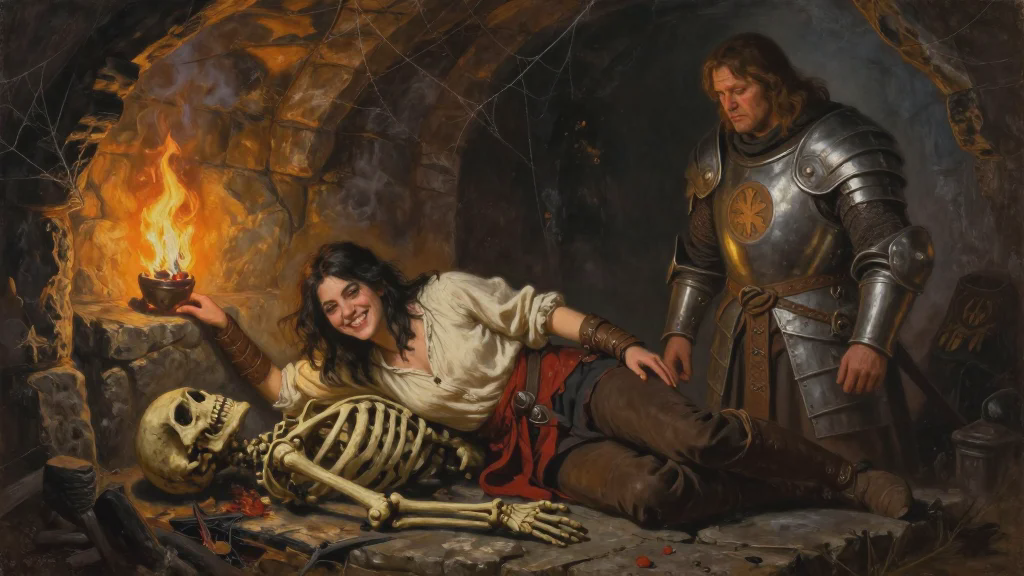
"It's a slab," Bancroft said. He took her under the arms and lifted her off the body, gentle as lifting a child off a fence rail, and set her on her feet, and she let him, which is the closest a noble thief comes to admitting a thing was a bad idea.
The mace had opinions. The mace had a great many opinions, all of them eager. It wanted to know whether the woman was a believer, whether Bancroft might give her a wooden token of the green god, whether perhaps a verse from the Book of Harvest and Mists might be just the thing to turn her. Hildrys Forest Green had been a man who burned to grow the faith, and dying had not cured him of it. Bancroft, who had never in his life talked a soul into anything and did not mean to start now, told it that the lady was spoken for. Clarice confirmed as much, cheerfully: spoken for by a mistress who is the guardian of the night, and who likes the dark, and who would not care for wooden tokens at all.
There was nothing behind the slab. When Clarice finally got her hand all the way back there, all she came up with was a wisp of burnt green cloth, light as ash -- the last scrap of a spider-silk robe that had been wrapped around a holy man for a hundred years and had gone up with the rest when she put fire to the room. She had charred her own clothes leaning across the body to get it. Bancroft did not say anything about that. It seemed to him the kind of thing the green god might arrange on purpose, and he has learned not to point such things out when they happen to other people.
A door opened in the dark across the room, and two red eyes looked out of it, and a clawed hand came through and beckoned. It was the mongrel-folk. The party had met their kind before, in a crooked sort of way, and these were friendly enough once they understood the torches in the doorway belonged to the people who had killed the necromancer and not to the people the necromancer used to send. We thought you were with them, one said. But it seems you are not. They asked the party in for bread.
Bancroft got his first good look at them then, and he will not soon lose it. There were three. One of them was hairless and had the largest backside Bancroft had ever seen on a living thing, swaying about under a scrap of cloth that was not equal to its work, and the others called him something Bancroft will keep to himself out of charity. One had a ridge of plates running off his skull and down his spine like the back of a lizard, furred everywhere the plates weren't, with a little scarf knotted under it for no reason a man could name. The third hung back with two boar tusks pushing up out of a toothy mouth and a spear held ready, and he did not trust them, and Bancroft thought the third one was the only one of them with proper sense.
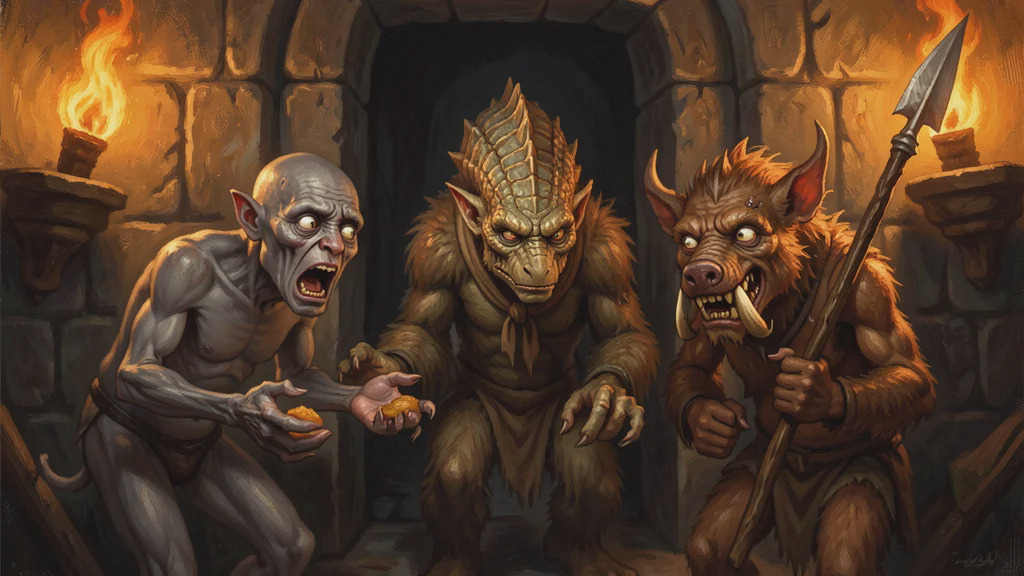
They wanted to feed the party. They had moss, and wrapped in the moss they had the heads of rats, and they pressed these forward with real warmth -- eat rat head, wrap in moss, eat good good, we have extra -- and were not the least put out when Anister allowed as how he'd had a big lunch. They flinched from the torches the whole while. The light hurt them, or frightened them, or both. How you live with such bright things near you, one marveled, the way you'd ask a man how he lived next to a smelter. Burn things. Burn easy.
Bancroft watched them and felt the thing a priest of the green god is supposed to feel and does not always manage to. These were not monsters. They were people the dark had got at and twisted out of true, and they were not well -- some of them wept a thin ooze from places that should not weep, and they were bent and wrong in ways that had nothing to do with how they were born. He looked for something he could lay a hand on and mend. There was nothing. Whatever was wrong with them was not the kind of wrong a prayer reaches. He had a relic in his pack that wanted to raise a temple and an army and pull a god back up out of the salted ground, and he stood there in front of three suffering creatures who only wanted to be left alone in the dark with their rat heads, and he could not do one thing for any of them. That is the part the mace never seems to consider.
They were generous in their way. They warned the party off every direction at once -- all danger, all the time, don't go north, don't go south, stay here -- and meant it kindly. They told of floaty things to the south that threw what you couldn't see, and a pit to the west that someone dumb had opened. They told, with a sorrow that came through even their broken talk, of one called Heather who had not trusted them and had run from them straight into something with tentacles. And they let Anister look in their bag of treasures, which turned out to be river pebbles and a seashell or two, worthless to anyone, rubbed smooth from handling and loved past all reason. Anister tried to trade for weapons and learned they had none worth keeping; he came away instead with a strange blue mushroom one of them pressed on him, a thing his herb-lore named a frost-breath. Then the folk grew nervous of the light again, and divvied their pebbles in the corner, and the party left them to it.
The day's leader was Anister, as it had been the day before and the day before that. They still settle it by the dice every morning, and the dice had taken a liking to handing Anister the job nobody wants, on the sound reasoning that whoever leads gets the blame when something comes out of the dark. He took it the way he takes everything, without complaint and with a plan.
They poked through a plain stone room where someone had stacked little towers of pebbles in the corners, the way an idle and unwell mind will. It looked like nothing. But Irulan has the sharpest eyes in the party for a thing that has been made to look like nothing, and where the rest of them saw a heap of rubble she saw a tarp with a few rocks glued to the top of it, laid down over a hollow. 🎲Party searches the room (Wisdom): Irulan rolls 19 and finds the cache; Anister 11, Bancroft 5, Clarice 3 turn up nothing. Under it was a stash some long-gone adventurer had hidden and never come back for -- a sledgehammer, a bundle of iron spikes, flasks of oil, torches, arrows, bolts, a little stoppered vial. The boot-prints around it were old enough to belong to a dead man. They took what they could carry and what they thought they'd need, loaded the hirelings with the rest, and left the heavy iron under the tarp where it had waited so long already.
Anister opened the south door onto a room Bancroft would have been glad to leave shut. It was a place for the dead -- alcoves cut in the walls, rows of them, each with its clay urn, the floor a litter of broken pottery and old bone, and a skull lying face-down in the rubble in the middle of it. Over the skull the air was moving, slow and wrong, when nothing else in the room moved at all.
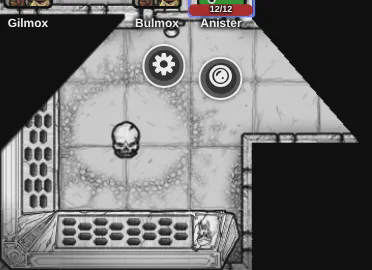
Bancroft took it for undead and did what he is for. He raised the holy symbol and called on the green god to put the thing down -- but the call did not come the way it comes when his god is easy with him. He felt the penance on it. The words had to push through something to land, like a man throwing a sack uphill, and the strength that answered was thinner than he is used to. Even so, the prayer took. The green light came up cold and sure, the way it always does when the god is listening. And then it closed on nothing. There was nothing in that swirling air for the turning to take hold of. The light went out into the room and found no death in it to drive back, and the thing over the skull never so much as flinched, because whatever it was, it had never been alive to begin with and so could not be made dead again. 🎲Bancroft Turn Undead, at -3 from Sylvanus's penance: nets a 14, and the prayer succeeds -- but it closes on nothing. The thing is no undead; the turning finds no purchase, and it never has to resist.
Anister, who had no way of knowing the prayer had landed on empty, took one look at the cold light catching nothing and did the prudent thing, which was to slam the door on the whole business. Bancroft let him. He was glad enough to have the door between them and it. They had hardly got it shut before the thing on the far side answered -- a great clattering crash of pottery hurled against the wall, and another, and another, an urn at a time, flung by nothing at all. It was the floaty thing that throws what you can't see, exactly as the mongrel-folk had promised, and it was in a temper now. Bancroft stood in the hall and listened to it break its own house apart and was content to let it.
Then Anister, with the racket still going behind the south door, turned and opened the north one to go put his questions to the mongrel-folk -- and they met him with their hands up, fretting like neighbors woken at midnight. What you do. Stop. We told you no. He had stirred up the very thing they'd warned him off, and now none of them would sleep for hours, and Bancroft could not fault them for the complaint.
To the west there was a pit, ten feet down and lined with spikes, and the spikes were black at the tips. Somebody had been here before them and cut the trap so it stood open, and at the bottom there was old blood on the iron and no bodies to go with it, which told its own story. There was no door past it that they could see, only the wanting to know what was on the other side, which in this party is reason enough.
They rigged a way across. Two iron spikes driven crossways into the wall, a rope strung between, so a body could edge along the lip leaning on the stone -- not a bridge, exactly, but better than a jump. It still wanted a steady foot. Clarice went over it like it was a garden wall, because she is a thief and clinging to walls is half her trade. They tied a rope around Bancroft for safety, on account of the plate, and walked him across slow with a man braced at either end, and he made it without grace but without falling, which is all he asks of most days.
Then Irulan went, and the pit took her.
It is a bitter thing, and Bancroft has turned it over since. Irulan is the strongest of them by a long way -- she is the one who lowers the rest of them into holes and hauls them out again, who shoulders jammed doors off their hinges. But the crossing did not ask for strength. It asked for a light foot, for nimbleness, and nimbleness is the one thing she has never had. On her strength she'd have walked it laughing. On her footwork she lost the rope, and pinwheeled, and the luck she dug for did not come, and she went down into the spikes. 🎲Irulan crosses the rigged rope -- a Dexterity check, her weakest suit, where her Strength would have carried her easily: she rolls 11 and starts to fall, burns a luck token to reroll, and falls anyway, down into the spiked pit.
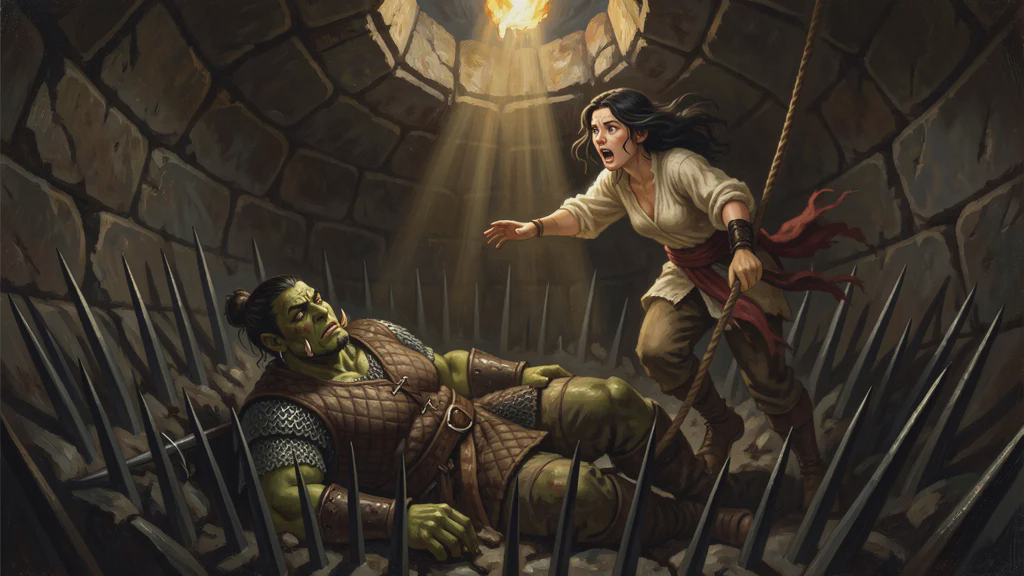
She had the wit, falling, to ball up the way you do, and it saved her from the worst of it -- she missed most of the spikes that would have finished her. But one went through her left side and one caught her at the neck, and by the time the sickening sound of it reached them she was crumpled at the bottom and not moving. Clarice was over the edge and climbing down to her before Bancroft had finished the prayer he'd already started, white-faced and saying Irulan's name.
She was alive. Barely, but alive. And here is the part Bancroft cannot make peace with. He poured the green god's healing into her, and his hands are slow now with the penance, but the prayer took even so -- the torn flesh drew shut, the bleeding stopped, the holes in her closed over. 🎲Bancroft Cure Wounds on Irulan: a 22, and the wounds knit shut -- but the black poison off the spikes will not answer to it. What it would not touch was the poison. The black on those spikes had got into her, and no prayer he knew would draw it, and no potion they poured down her did a thing but make her gag. Anister's curative bought her back to her feet for a moment, and no more, and still the poison sat in her getting worse. 🎲Anister's curative: a 20, restoring 3 -- enough to stand her up, but it does nothing for the poison. In the end it was not the priest and not the magic. It was Anister, who had to cross the pit himself to do it, kneeling over her with his herb-pouch and his root-lore, feeding her one foul draught that did nothing and then a fouler one that worked, until the poison let go of her. The mushrooms and the roots did what the green god's own priest could not. Bancroft has thought about that. A man carries a relic in his pack that means to raise a temple and a holy war, and when his friend is dying of poison in a pit it is the quiet archer's bag of weeds that saves her life.
Irulan lived, and stood, and was herself again by the slow measure of it, but the pit kept a piece of her. She carries a new scar now -- a hole bored clean through her left side, front to back, healed over but always there -- and she is a little less hale than she was the day before, a measure of her strength left at the bottom of that hole for good. She took it the way she takes everything, with a curse and a shrug and a remark that she'd died worse. Bancroft said nothing clever. He had handed a torch to a hired man last week and buried what was left of him. This week the strongest of them went into a pit on a roll of the dice, and lived, and he was grateful past speaking, and he kept the gratitude to himself where it belonged.
After that, Bancroft wanted out. He wanted Irulan above ground and he wanted to be about the business of his penance, which sat in him heavier the longer he carried it. But Anister had found a bricked-up wall, and a bricked-up wall is to Anister what a locked box is to Clarice -- a question he cannot leave alone.
A second knot of mongrel-folk drifted through while they argued it, new ones: a thin one made all of straight lines like a man stretched on a rack, one with tentacles where his fingers should be, one with the legs of a goat. They didn't trust the light any better than the first lot, and slipped off as quick as they'd come. The party put it to a vote -- whether to take a sledgehammer to the wall and bring the whole barrow down on their ears with the noise, or leave it. Bancroft voted to leave it. He has no taste for racket in a place full of things that come when you ring the dinner bell. They settled on a middle course: Anister chipped a small hole through the brick instead, slow and quiet, and reported the wall was three courses thick -- three wythe, he said, and took a ribbing for the word, which nobody believed was real and which turns out to be exactly real, the way most of the things Anister says turn out to be. Through the hole was a hallway, and a door, and nothing worth dying over that they could see. Anister added it to the map he keeps, which by now is a fair likeness of the whole sprawling warren -- every chamber and corridor and pit they've bled for, set down in his careful hand so they need bleed for it only once.
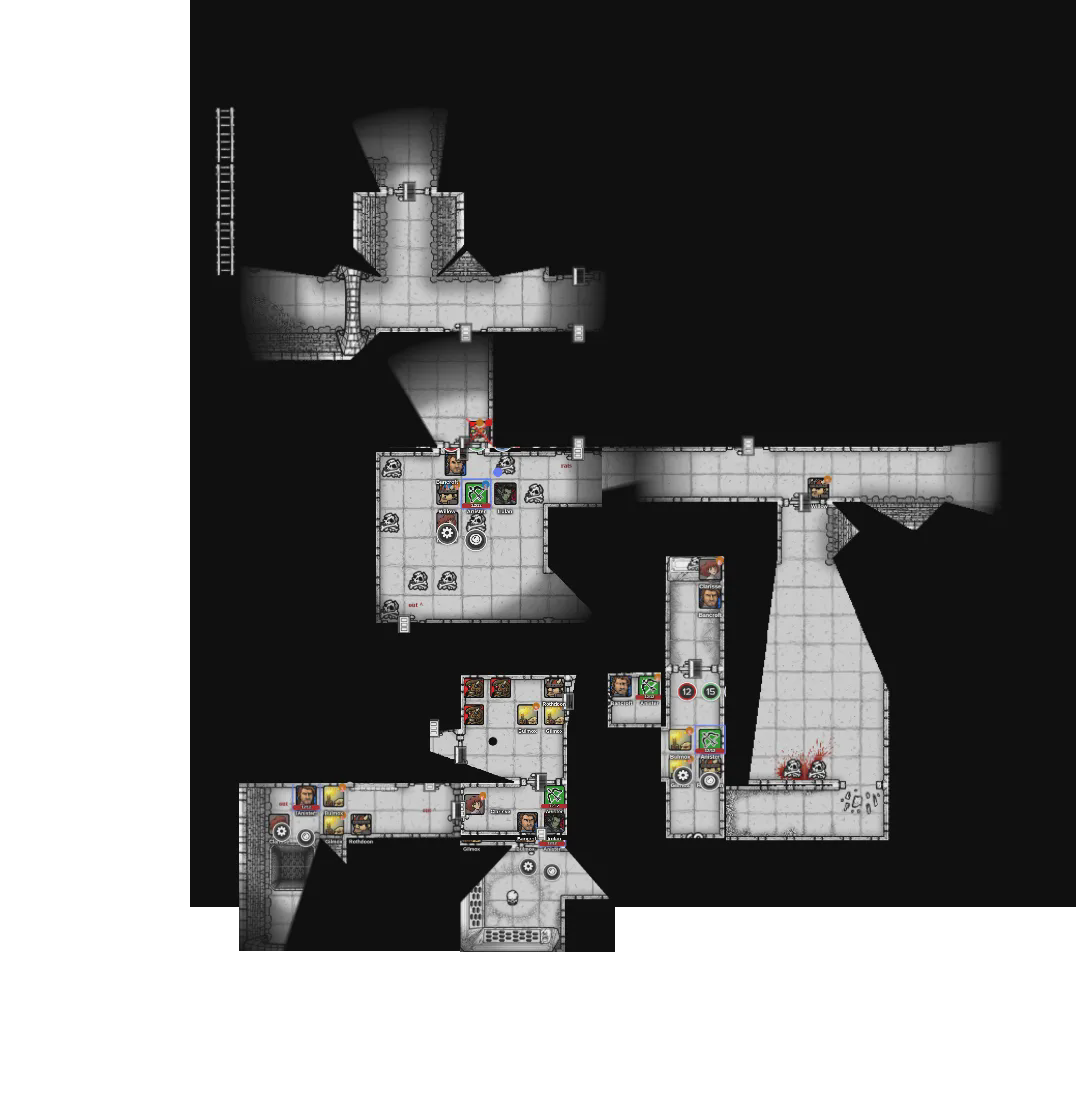
So they called it. Irulan was hurt, the relic was in the pack, and the day had cost enough. They turned back toward the rope and the daylight.
Clarice went up the rope first to scout, easing the shutter of her heirloom lantern open a crack at the top -- and froze. Down at the mouth of the barrow, where the daylight came in, there were people on the steps. A whole company of them, torches lit, coming down into the dark. She counted six and there were ten. She very nearly tipped the lantern off the lip in her hurry, thirty feet onto the stone and the rest of them, and caught it at the last by a hair's breadth, and slid back down to tell them the barrow had visitors of the adventuring kind. 🎲Clarice scouts the entrance (Stealth, advantage): 15 -- she spots the rival company first, and a luck-token save keeps her lantern from tipping off the lip onto the party below.
There was no fighting ten of them and no call to. They pulled back into a side room and went quiet, and Clarice set herself at the door with a candle to listen, and the door opened on her with the candle right in her face, and there was nothing for it but the deer-in-the-lantern look and a quick tongue.
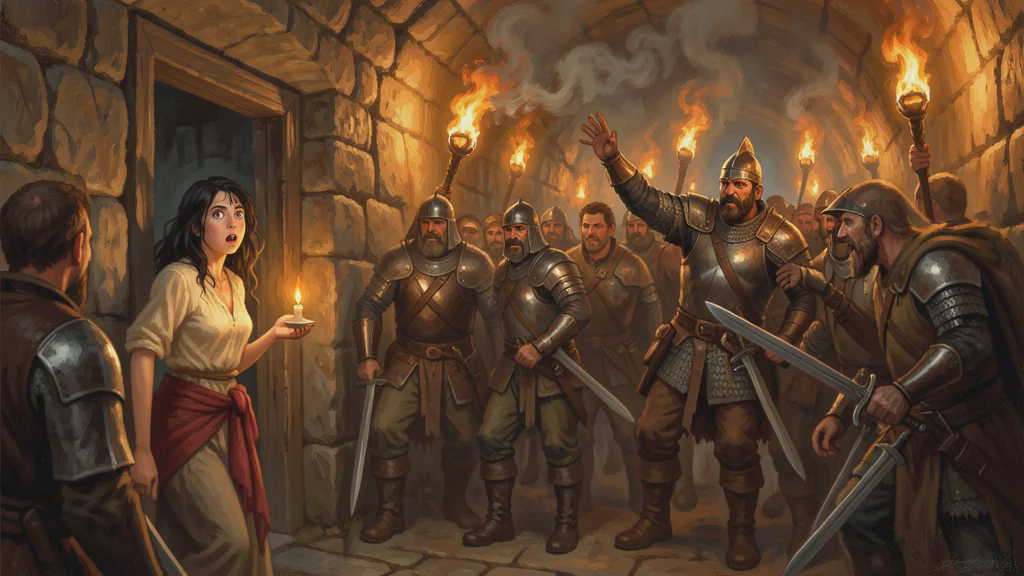
She has the quick tongue. Well, well, the front of them said, look what we caught peeping -- a little lost mouse. And Clarice became, on the instant, exactly that: a poor lost girl whose cruel companions had left her down here in the dark, who had very nearly died, who only wanted to go home. She is very good at being whatever the moment needs her to be. The leader of the company turned out to be a decent enough sort under the swagger -- he called his lads off her, told them there was no sport in frightening a lost lady, and offered, for the price of one gold piece, to see her safely up the steps. 🎲Clarice plays the lost, helpless girl for the company (Charisma): a 21. The leader waves his men down, offers to escort her up for a gold, and tries to hire her on -- they're short a thief. He even tried to hire her; they were short a good thief, he said, and she had the look of one. She thanked him and begged off and promised to come round on the morrow, and when she tried to call out loud enough for the rest of the party to hear, he hushed her like a fond uncle -- quiet, miss, you'll bring the whole barrow down on us, don't you know that yet?
Then the company formed up and went on into the dark, south, and the leader said the thing that has stayed with Bancroft. Right, lads. Let's go kill us some mangy mutts.
That was what they had come for. Not tombs, not gold -- the mongrel-folk. The bent, weeping, frightened things that had warned the party off every dangerous door and pressed rat heads on them out of plain crooked kindness were vermin to be cleared, to ten armed men with torches. Clarice came back through the dark to the party by a knock she'd worked out, sick about it, wanting to do something. There was nothing to do. Ten to four, with Irulan barely off the floor of a pit, was no arithmetic for a rescue. They told each other the only comfort there was, which was true as far as it went: the mongrel-folk make their whole living hiding from worse things than this, and they would likely slip the net the way they always had. Bancroft hoped it. He carries a god who is supposed to mind the small and the broken, and he climbed up out of the ground and left the small and the broken to take their chances in the dark, because there was nothing in his hands that day to do otherwise.
They got out clean. Irulan, never one to let a little dying slow her down, hauled the hired men up the rope and wore herself thin doing it, sore and tired the rest of the day for the trouble. Somewhere behind them in the dark the dry rattle of bones kept pace, drawing nearer and never quite arriving, all the way to the surface. Then they were up in the grey afternoon light, and it was gone six o'clock, and the long walk back to Helix was in front of them.
The first trouble in town was carrying the thing at all. The Green Way is a Green Man's mace and looks like exactly what it is, and Helix belongs to Saint Ygg now; a paladin would mark it across a market square. So Bancroft wrapped it and kept it close and out of sight, which is a strange way to carry a holy thing, hiding your god's own weapon from the people who hold the town.
Then there was the penance to pay, and nowhere to pay it. There is no church of Sylvanus in Helix. There hasn't been since the purging -- every statue thrown down, every shrine broken. The one place left is a statue of Hearn the Hunter that stands out past the town line, and Hearn and Sylvanus are old kin in the way the country folk keep them, so the statue of the hunter has somehow been let stand where the green god's never could. Bancroft went out to it, and there he found what he was looking for, which was not a temple but people. Poor farmers, a few of them, who still quietly keep the old faith out where the fields are and the paladins don't bother to look. He paid out his twenty gold among them in the plain way -- to people who needed it, for the doing of plain good -- and somewhere in the middle of it he felt the weight come off him, the god easing at last, his hands his own again. It had taken a burned grave and a near-dead friend and a day in the dark to learn the lesson, which was only ever the lesson the green god always teaches: do better, and do it small, and do it for someone who needs it.
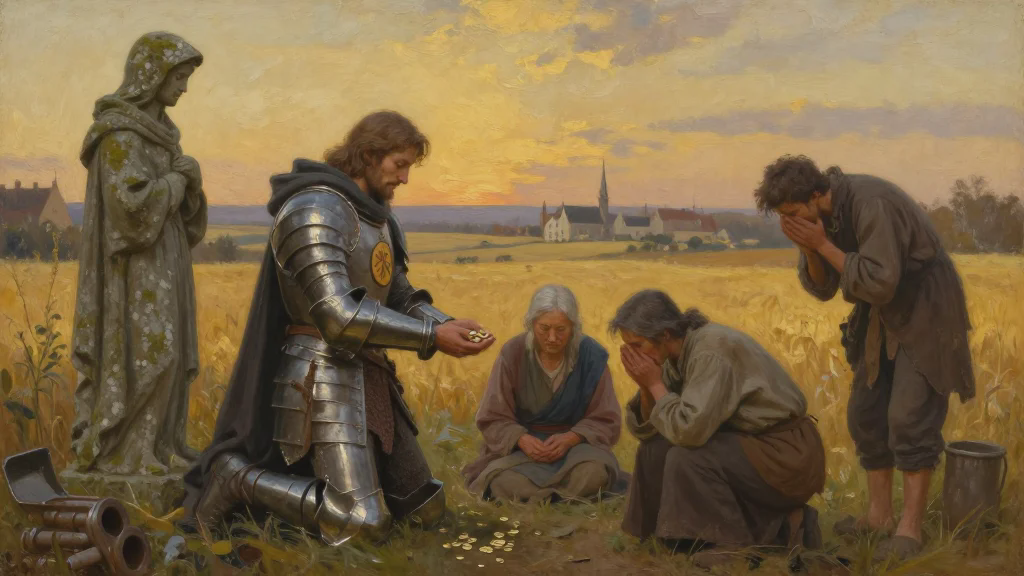
The most faithful soul he met all day was a gong farmer named Nora. She hauls the town's filth for a living and she stank of it to heaven, and she prayed to Sylvanus with a plainness that shamed the grand notions Bancroft had been carrying around since the morning. Thank you for calling it gong, she said, when he gave the work its honest name and not the cruel one. She told him what he was beginning to understand on his own: don't show the green god in Helix, look to the farms, look to the north -- and then her eyes went far off and she said it again, to the north, past the Black Forest, the way people say a thing that isn't all the way theirs to say. Then she shook it off and asked him to pray for her, and gave her name, and went back to her work. Bancroft has met priests in fine robes with less of the god in them than that woman had under all that muck.
It was on the way back through the heart of town, in sight of the great temple of Saint Ygg, that the mace tried to take him.
It had been muttering all day. Now it screamed. There was a temple of the thing that had murdered it standing whole in the middle of the city, and there were paladins of Ygg within reach, and the Green Way wanted blood and wanted it now -- find the nearest one and kill him, there is no way this stands, I will have my vengeance. And Bancroft felt his own feet start to carry him toward the temple door with his hand going to the wrapped haft, and understood with a cold drop that the wanting was no longer all his to refuse. 🎲The Green Way seizes Bancroft in sight of the St. Ygg temple and tries to march him in to kill a paladin (Charisma save vs 13): he rolls a 10, two short, and is compelled toward the door -- then burns a golden luck token and wrenches himself free.
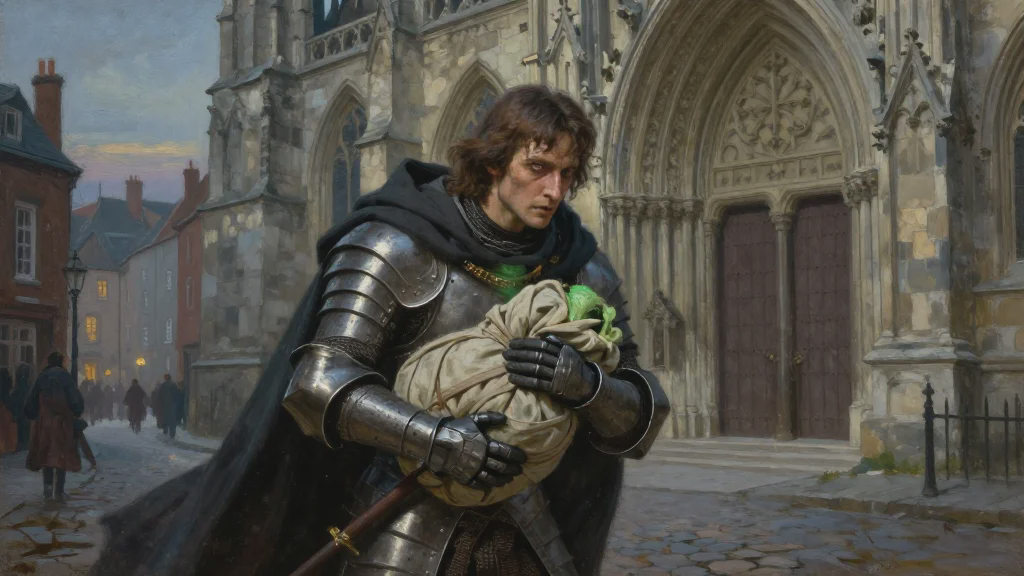
He stopped himself, but only by digging deeper than he knew he had in him. It was that close. He stood in the street with his eyes clearing and made himself talk about seeds, about planting, about anything green and slow and alive, until his feet were his own again, while the mace raged in his skull that he was weak, that they had been made small by the enemy and he would not even avenge it. You have to sleep sometime, it told him, which Bancroft has decided to take as the threat it plainly is. The dead priest in the mace had a way of choosing strength over sense, and Bancroft did not have to be told twice that it was exactly that way of thinking that had got the man killed and buried in webs.
So now he has a choice to make, and a couple of weeks to make it. The thing is a true relic, important enough to raise a church around -- enough to call the green god back up out of the salted ground, if the right hand carried it. He could be that hand himself: take up the Green Way, found the Church of Sylvanus, and pass out of the ordinary run of his days into something larger and quieter and done. Or he could find a worthier man, a real priest, someone built to lead a faith, and put the mace in his hands and go on being Bancroft. He will not sell it to Maza for coin, whatever the others joke; some things you do not do.
And here is the truth of it, the thing Bancroft knows about himself: he is a simple man. The head of a church ought to be more than he is. A faith coming up out of the ashes deserves a better shepherd than a farmer who reads slow and prays plain. So he means to look, and look hard, for the right person to carry this. But he comes off a farm, and he knows how a farm works. When a thing needs doing and there is nobody else to do it, you do not stand around being humble about your fitness for the job. You spit on your hands and you do it. If the right man never comes, then the wrong man -- a plain man, an unworthy man, a man who would much rather be putting in fence posts -- will pick up the Green Way and carry it the best he can. That is the nature of things that grow. You tend what's put in front of you, whether you reckon yourself fit for it or not.