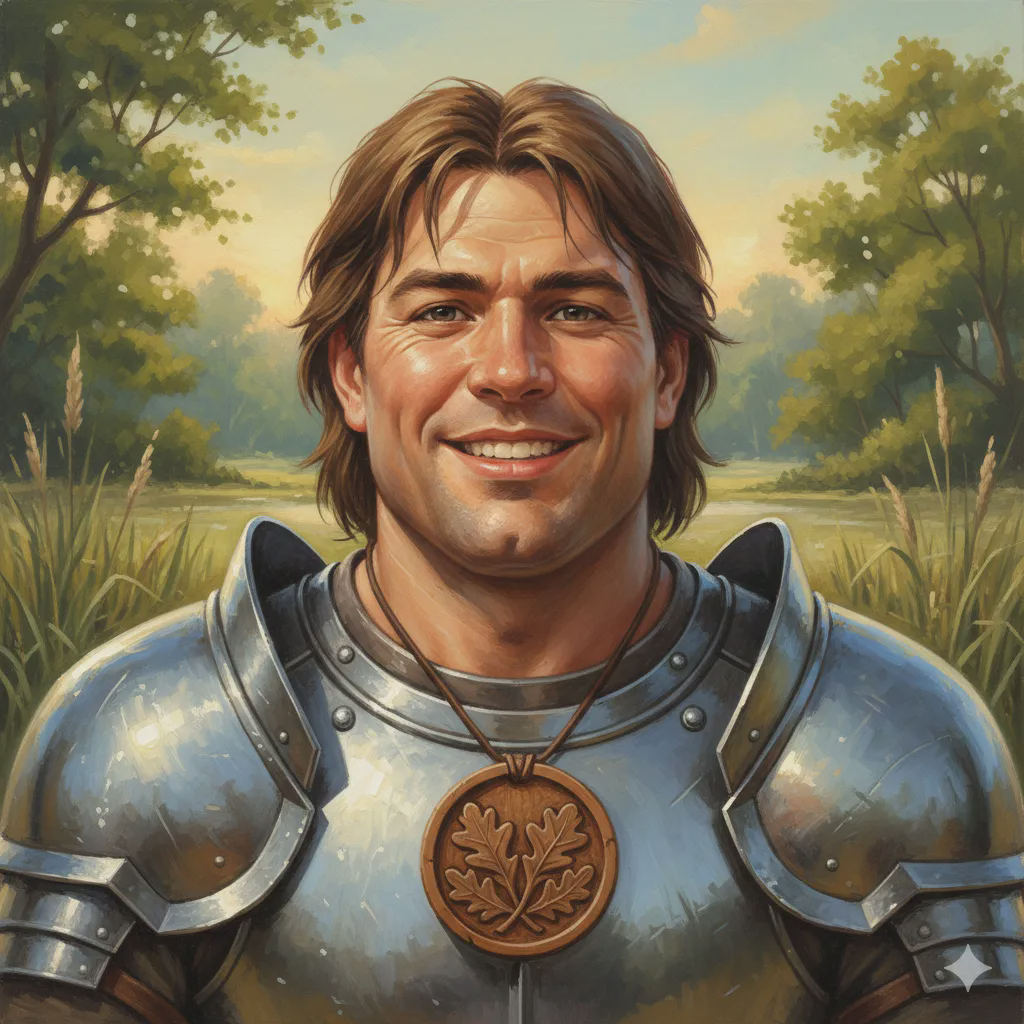
The Search for the Green Way
He wrapped the mace in a horse blanket the night they got back, and tied it shut, and set it on a chair across the room as far from his bedroll as the room allowed, and he still woke in the night with the feeling of being looked at. In the morning i!t was the first thing he saw. The blanket had come open at one corner and the carved face was pointed straight at him, and there was a thin smoke coming off the green wood that no fire accounts for, and the mace had not moved an inch, and Bancroft lay there a while in the grey light and considered the kind of life a man has signed up for when his god's own holy weapon spends the night staring at him and steaming.
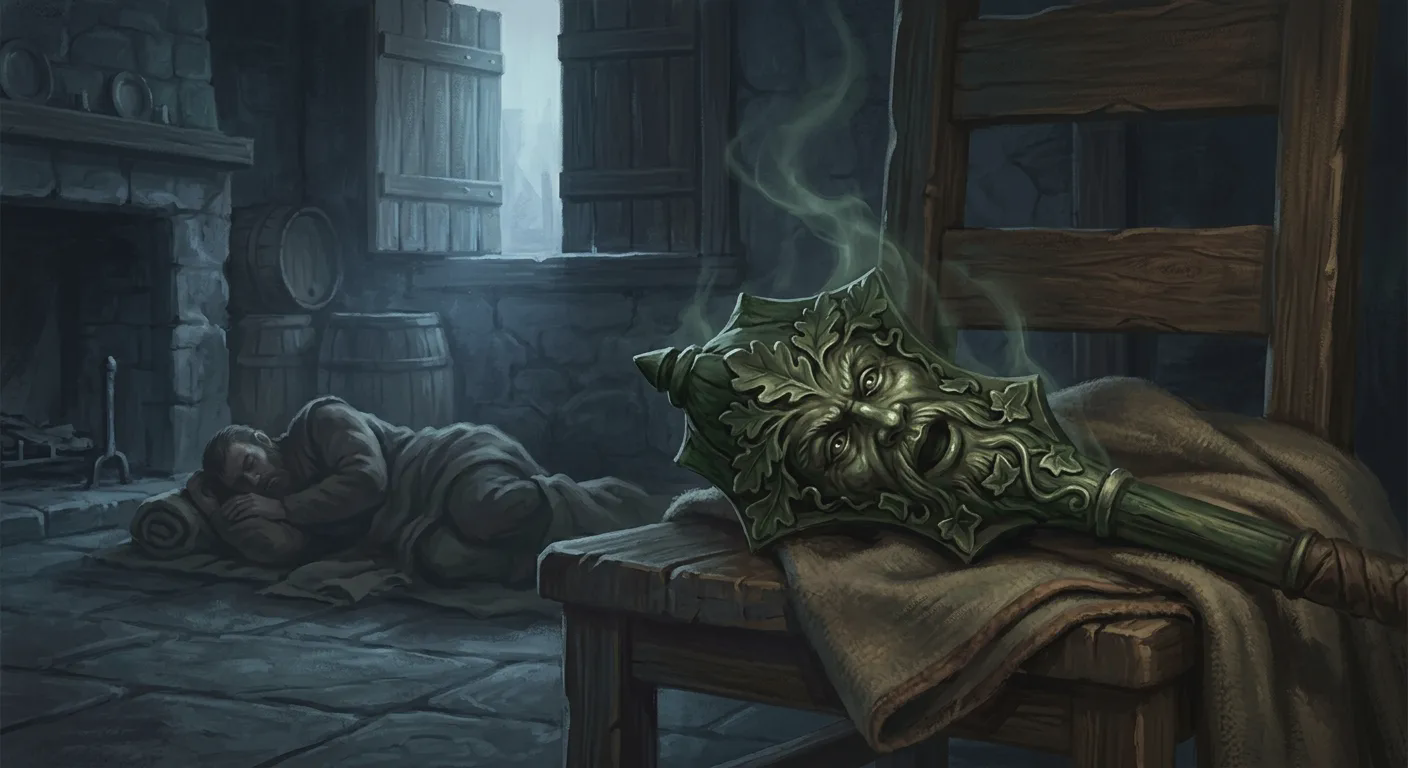
The Green Way wanted to go north. It had wanted to go north since the moment his hand closed on it, and a night's sleep had not cooled the wanting. There was a man up there, it said, or the idea of a man -- someone worthy, someone to raise the green god's church up out of the salted ground and put a hand to the work that Hildrys Forest Green had died for. North, past the farms, into the Black Forest where the spiders are. I sense him, it told Bancroft, the way you'd say you sense rain coming, and it could no more point to him on a map than the weather can.
Everyone Bancroft asked told him the same thing about the Black Forest, which was: don't. It was where the silk came from, the fine black spider-silk the miller's wife wove into cloaks, and the reason it cost what it cost was that the people who went after it mostly did not come back. Webbed-up bodies hanging in the trees. Goblins, hobgoblins, ogres, things with tentacles. A man at the inn said it the way men say a thing they have watched happen to other men. Bancroft heard all of it and weighed it against a steaming mace that had promised, in plain words, you have to sleep sometime, and decided that on the whole he would rather take his chances with the spiders.
He could not take them in plate. That was the first hard fact of the morning. In his good harness it was three days' march just to reach the trees, slow as cold honey, and the others would be standing in the dark waiting on him the whole way. So he did a thing that went against his nature, which was to take off the heaviest armor he owned and pack it in a chest under his bed and walk out into the worst country he knew of in a suit of boiled leather. A farmer keeps his good coat for going to town and his old one for the field, and Bancroft understood the sense of it, but a man feels the want of the steel when he is walking toward a forest full of biting things. Irulan, who is the only one of them with two coins to rub together, spotted him the difference for a shirt of chain off the stores, and the dice were kind about the trade for once.1 He kept the shield. A man can give up a great many things and still keep his shield.
There was a mushroom in his pack that the mongrel-folk had pressed on Anister a week back, a frost-breath, blue and cold-looking, and it would not keep. Bancroft tried to give it away first to the inn's cook and then to the cook's wife, and got nowhere -- they run a sausage-and-gravy house, the wife told him, not a place for queer blue mushrooms, take it to the bloated halfling in Iron Guard Mott if he wanted fancy. So rather than let a good thing rot he ate it, and it went down cold and minty and left him with a breath like a mountain stream, which is a foolish thing to carry into a forest and did nobody any harm. There was also a little copper-colored vial they'd hauled up out of the dark with no label on it, and Maza wanted twenty-five gold to say what it was, and Bancroft decided he would sooner not know and drink it blind if the day ever came that blind was all he had left.
They paid the innkeeper to hold their rooms a week against the chance they didn't come back, and Bancroft asked the man to set aside any odd gear that came through -- rope, scrolls, weapons, the leavings of people who'd stiffed him by dying in the Barrow Maze -- and then there was nothing left to do in town but leave it. So they left it. Irulan had the lead this time; the dice handed her the job the way they'd handed it to Anister all the days before. The three of them and a god in a blanket, walking north out of Helix into the farms.
The farms were where Bancroft learned the thing he is still turning over.
They went farm to farm in the first day's rain, asking after anyone who might still keep the old faith, anyone who'd know a way to the ruins the mace kept pulling them toward. The answers were all the same and all afraid. A boy of ten guarding a driftwood hut threatened them with his parents' pitchforks. The parents, when they came in from the field, were worse -- a man in a wide-brimmed hat with his wife behind him, both of them quick to say they were dedicated subjects of Saint Ygg who'd paid their monthly dues, thank you, and what did the strangers want.
Then the farmer saw the mace.
Bancroft had it half out of its wrapping, and the man's whole face changed. Not to anger. To fear, the working kind, the kind a man wears when you've shown him a thing that could get you both killed. Put it away, he said, low and fast, glancing back at his own fields like the furrows might be listening. You'd get hanged in Helix for that. Put it down, you're making me nervous. He knew it on sight -- the green face with its open mouth and the ivy coming off it -- the way you only know a thing you grew up with. And when he'd got Bancroft to cover it back over, and looked around once more to be sure, the hard set of him eased by just a hair, and he said, quiet, almost to himself: May the Greenway provide.2
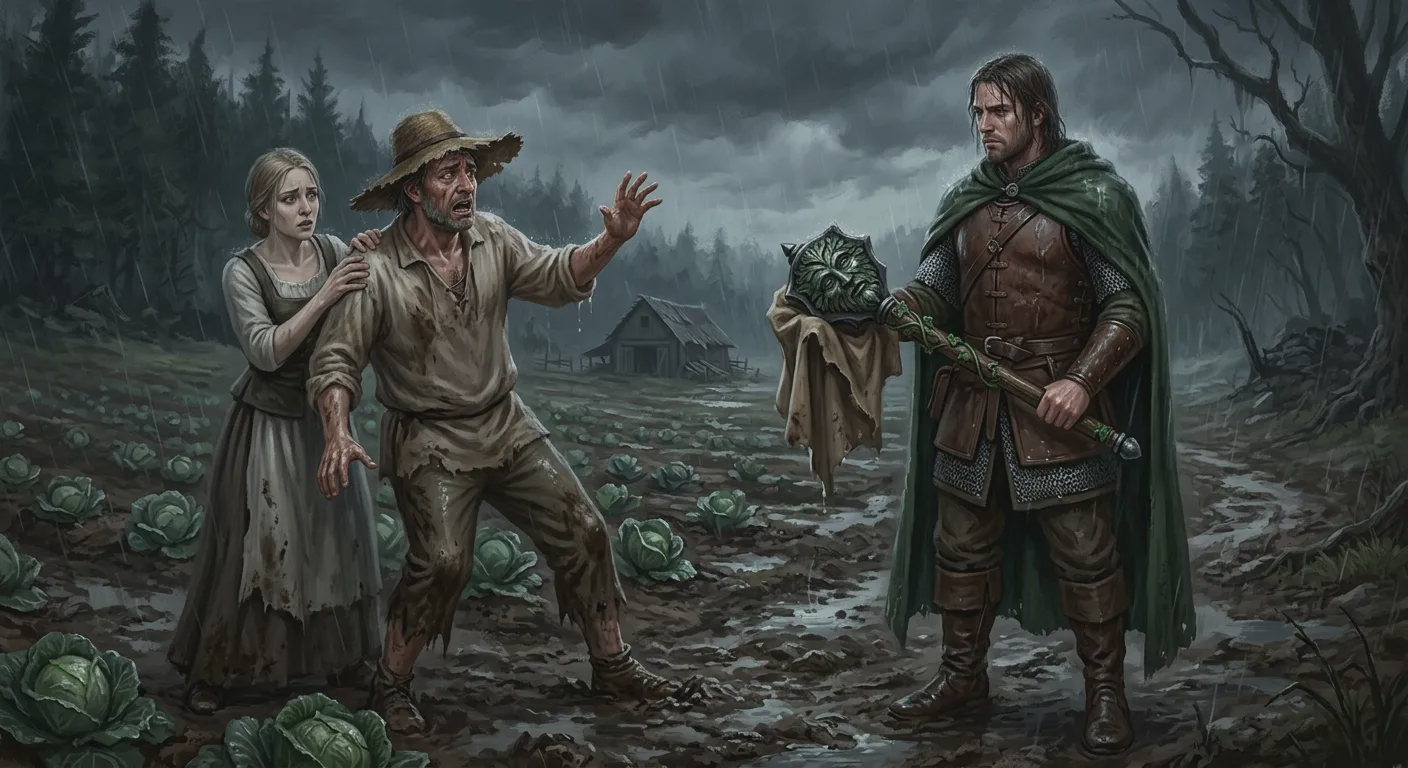
He wouldn't help them past that. Swore he knew no priests of Sylvanus, they'd all died out years ago, and a man who valued his land wasn't fool enough to worship anything but the saint these days. Warned them off the Black Forest in the bargain -- he'd cleared bodies out of the north himself, he said, webbed-up bodies, and it would grieve him to clear out three more. But Bancroft walked away from that field knowing something he hadn't known going in. The green god is not dead in this country. He is only hiding, the way the farmer hid that one whispered blessing under all his loud devotion to the saint, the way Bancroft himself was hiding a mace under a horse blanket. There are people out here in the mud who still say the old words when they think no one who matters can hear. He had been carrying the Green Way around like the last ember of a fire gone out. It turns out the fire is only banked.
He didn't say any of that to the mace. The mace would have wanted to march back and start a war about it.
The country got harder the farther north they went. Nobody would take them in -- they were strangers in the rain, and one of them a half-orc, and word ran ahead of them down the farms faster than they could walk, so that by the time they reached a place the people there had already decided to give them the cold shoulder and a closed door. They slept the first night in the lee of a stone with the rain coming down, and ate what they had, and watched in turns. Anister read the ground as they went, the way he does, and one stretch of it troubled him: tracks, big ones, ogre-sized or bigger, with a wrong twisted talon where a foot should be, marching off east and south. Whatever made them was a giant of some kind and was not going their way, which was the only good thing Bancroft could find to say about it. They marked it and went on.
Then the farmland gave out and the Black Forest took them in, and it was everything the man in the hat had promised. The canopy closed over until noon looked like dusk. The ground turned swampy and breathed up a smell like struck matches. The roots came up out of the muck in knots a man could break an ankle on, and over all of it, everywhere, strung between every two trees, was the webbing -- thin and wispy and pale, so much of it that they were walking through strands of it without meaning to, wiping it off their faces, not yet understanding what a forest that full of web was trying to tell them.
The frogs were the forest's first joke at their expense. They came around a stand of trees and there were a dozen of the things squatting in the muck ahead, big as bloodhounds, with a grey crust over their backs like bark, croaking and snuffling through the leaf-litter after whatever frogs that size eat. They hadn't noticed the party yet. Irulan and Anister melted back into the trees easy enough, but Bancroft in his leather is no woodsman, and a stick went off under his boot like a shot, and all dozen heads came round at once and the whole croaking mass of them started his way.
It was Anister who saved it, and he did it without lifting a weapon. The man has a trick of throwing his voice -- bouncing a sound off into the trees so it seems to come from somewhere he isn't -- and he did it now, pitched it off into the dark away from all of them, and the frogs froze and turned and tried to work out what was making that noise in the black wood. Then they decided in a body that they did not want to know, and went hopping off the other way as fast as their fat legs would carry them.3 Bancroft has come to set a real value on the quiet archer. There is a kind of fight you win best by making sure it never starts, and Anister is the only one of them who reliably knows how.
The poison was no joke at all.
It came from the foraging. They were thin on rations from the first and getting thinner, and Anister kept them fed off the land as they marched, berries and roots and the like, which is his proper work. One evening's pickings were bad. He ate before anyone thought to look twice, and within the hour he was on his knees being sick, shivering, gone grey, saying the blackberries weren't blackberries. The stuff sat in him for two days. He was at half himself the whole of it, weak and starving on top of the sickness because everything he tried to eat came back up, and -- here is the part Bancroft has filed away with the others like it -- there was not one thing the priest could do about it. He laid hands on the man and called on the green god and the prayer went out and found no purchase. His own restoratives, the herb-craft he's so good at, failed him one try after another. In the end the poison simply wore itself out the way poison does, and let go of him about midday on the third day in a manner Bancroft will spare the reader the particulars of, and Anister stood up hollow-eyed and hungry and more or less alive.4
Bancroft has now watched, twice running, his god's healing slide right off a poisoned friend while plainer remedies did the work or no remedy did. He is a cleric of a green and growing god and he is starting to understand that green and growing does not mean a man never rots. The forest does not care what you worship. It poisons the faithful and the faithless alike and waits to see who's tough enough to keep walking.
The spiders were in the storm.
By the time they found them the rain had built to a real thunderstorm, lightning and all, the kind that turns a dark wood into a thing seen in flashes -- black, then a glimpse of everything, then black. They were creeping north through the worst tangle of web yet, the strands so heavy with rain they hung down like wet rope, when a strike lit up the canopy right over their heads and Bancroft saw them. Six of them. Bulbous black bodies the size of small horses, folded up in the high branches on legs like bent spears, and in the noise of the storm not one of them had noticed three soft warm things creeping along below.
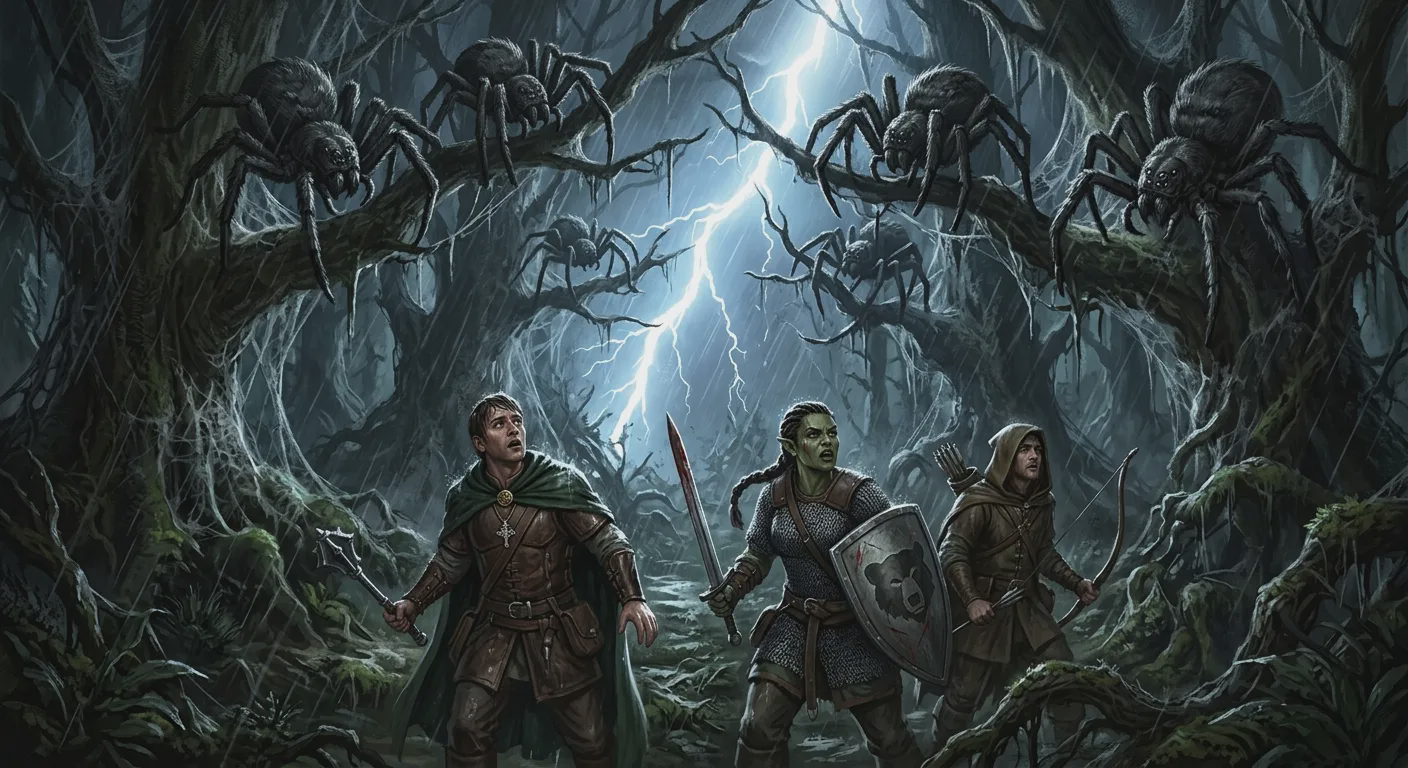
There is a version of the night where they get past. They tried for it. Move slow, make no sound, slip under the sleeping things and keep going. They'd have managed it, too -- the dice went bad for all three of them at the worst moment, but Irulan and Bancroft both dug deep and pulled it back, the two of them in chain and leather somehow quieter than the woodsman.5 But Anister, easing along under the spiders, mistimed a step against the thunder. He moved in the quiet half-second between two crashes instead of under cover of one, and his boot came down loud, and the high branches came alive.
What followed was not a fight so much as a long, bad argument about how to leave.
Anister tried first to make friends with them. He stood under six descending spiders and made warm welcoming gestures and as much as said hello, friends, good to see you, on the theory that they were creatures of the forest and he is a man of the forest and surely something could be worked out. It does not work on spiders. You do not reason with a thing that knows only hunt or be hunted, and the most Anister got for his trouble was the DM reminding him, more or less, that you can't hold a conversation with a chicken. So he changed tack and did the thing that actually moves a spider, which is fire -- struck a spark off his flint onto the nearest web and got it to catch even in the wet, and one of the six shrank back from the little flame and dropped away into the dark. That left five.
Bancroft tried to do his part and the mace would not let him.
He has a prayer that wraps a weapon in cleansing flame, holy fire, the green god's own, and against five spiders in a wet wood it seemed the very thing. He called it up. And Irulan, watching, saw the flame come down toward the head of the Green Way and saw the carved green face open its mouth and swallow it -- drew the fire right down into itself and snuffed it out, the way you'd pinch a candle.
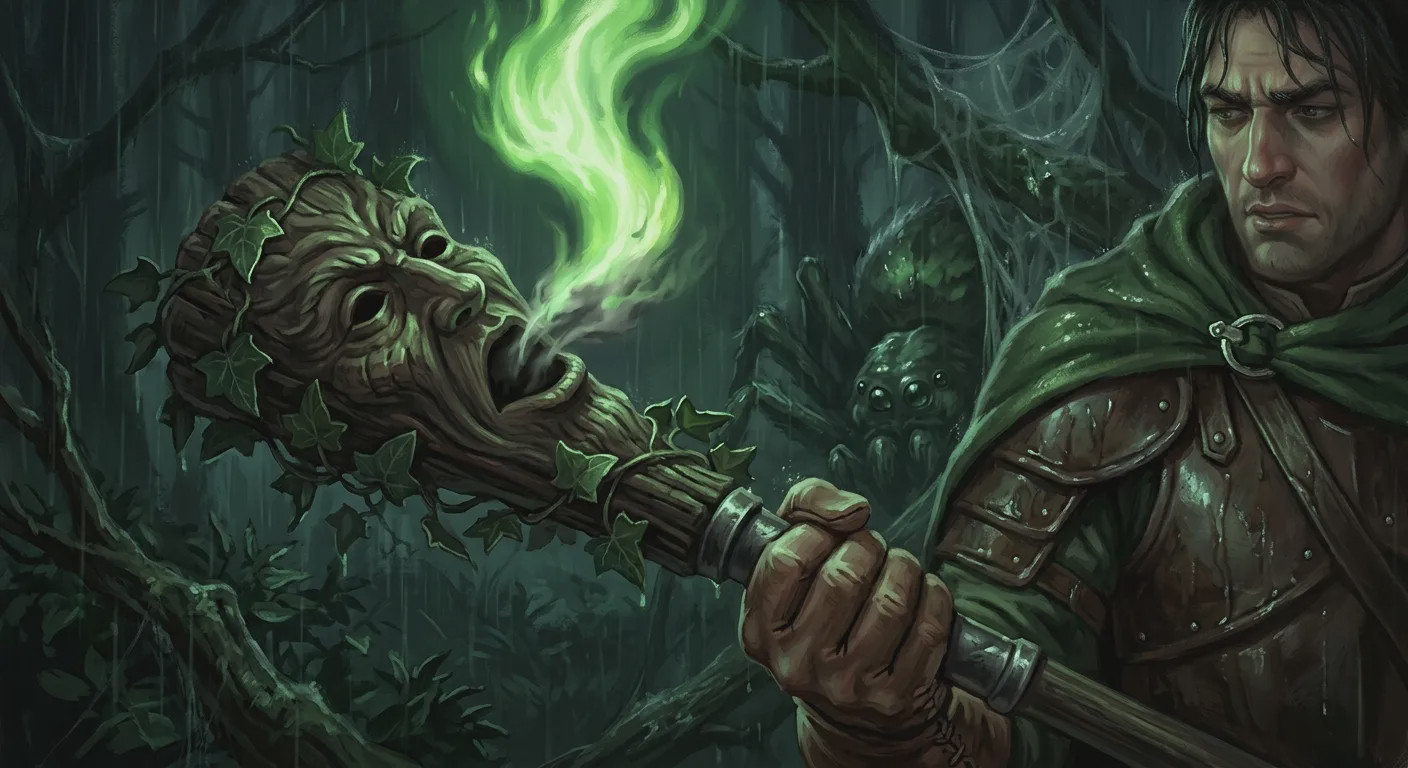
The mace would not burn the spiders. Bancroft felt the refusal land in him like a cold word: these are natural creatures, the dead priest in the mace told him, plain forest things, and you will not raise holy fire against them. Find a new friend, it said of Anister, almost bored. Friends are easy to come by.6 It took a second try before the flame would hold at all, and even then it was clear the green relic had only the one mercy in it. A mace that had screamed all week for the blood of paladins, that had tried to march Bancroft into a temple to murder a man, drew a hard clean line at hurting a spider. Bancroft is still working out what to make of a god whose weapon will start a holy war but will not let you scorch a bug.
Irulan, who has no patience for any of this, charged in past both of them with her sword and her shield and her best half-orc bellow, meaning to put the fear of God into the things by main force. She picked the exact instant of a lightning strike to do it, and the thunder ate her war-cry whole, and the spiders never heard a sound.7 It was that kind of fight.
In the end the spiders settled it themselves, in their way. One of them spat web and took Anister -- not to kill, he understood; they don't fight what they can wrap and save, and they wanted him put by for later like a ham in a smokehouse. He gave up his shield to it, let the strands take the shield instead of the arm, and the spider hauled the thing up into the canopy and chewed on it a moment and found it was wood and metal and no good eating and flung it aside. The same spider, reaching for him again, somehow fouled itself in its own effort and came up lame and could web no more -- Bancroft heard the DM name the creature Carl, and heard the others laugh, and was glad of the laugh because there had been precious little to laugh about. Carl's failure bought them the opening. They stopped trying to win and simply ran -- broke and scattered north through the trees in the rain, and the dice let them go by the width of a hair, and after ten minutes of crashing through the dark the spiders lost interest in the chase and let the forest swallow them back up.8
Nobody died. In the Black Forest, Bancroft is learning, that counts as a clean day.
They came out the far side of the spiders soaked and shaking and no closer to whatever the mace was after. It had a new thing to say by then. Crying babies, it told him -- it could hear them, off to the north, and would he not keep on toward the sound. Bancroft could hear nothing but rain and his own heart still going hard, but north was the only direction the thing ever gave, so north they went. He spent what strength he had left on a small mercy: a blessing to put back the luck Anister had burned keeping himself alive, which is the sort of prayer the green god answers gladly and the sort Bancroft would rather be saying anyhow.9
They found a cave that evening, a real one, dry and empty, the first honest shelter the forest had offered, and Bancroft was nearly as grateful for it as for surviving the spiders. They built a fire across the mouth of it -- spiders don't like fire, the one lesson the night had taught them -- and Anister, who knows that a forest full of spiders is a forest full of larders, climbed a tree to a cocoon the next morning and cut a webbed-up fox out of it, enough meat for three days, and got back down before anything came to ask what he was doing.10 It was not much. Three rations of stolen fox in a cave in the rain. But they had walked into the worst country in the world on the word of a relic, and they were three days in, and they were fed and dry and all of them still breathing, and a man who comes off a farm knows to be thankful for a roof and a meal and does not ask the weather to be more than it is.
The mace still says north. There are mountains somewhere ahead, a hint of them through the trees, and a sound only the dead priest can hear, and a man up there the green god is supposed to want found. Back in Helix the innkeeper's patience is running out on their rooms, and one of these mornings he'll auction off Bancroft's good plate to a stranger, and there is nothing to be done about it from here. Bancroft thinks about that plate sometimes, packed away safe in a chest while he walks around a spider-wood in boiled leather. It seems to him a fair picture of the whole business. You put down the heavy thing that kept you safe, and you pick up the light thing that lets you move, and you go where you're sent, into the dark, after a man you've never met, because a voice you can't argue with says he's out there and the work won't do itself. That is most of what faith has ever asked of him. He keeps walking north.
-
The party arranges to draw a shirt of chainmail and a shield from stores; the transfer comes down to a single d100 -- needing 51 or higher, Bancroft rolls 93 and gets the kit, letting him trade his plate for speed. ↩︎
-
Bancroft works the farms with a Charisma check at disadvantage to find anyone sympathetic. He turns up no help and no priest -- but the farmer recognizes the Green Man mace on sight and, once the fear passes, murmurs "May the Greenway provide," marking him as a secret keeper of the old faith. ↩︎
-
Surprised at thirty feet, the party rolls to slip away; Bancroft is heard and the dozen wood-frogs give chase. Anister answers with a thrown-voice ventriloquism trick (Charisma) and spooks all twelve into fleeing. ↩︎
-
Anister eats poisoned forage and is left sickened -- weakened and starving for roughly two days. His own Restorative rolls fail repeatedly and Bancroft's healing finds no purchase on it; the poison only clears when it runs its course. ↩︎
-
All three botch the Dexterity checks to creep beneath the sleeping spiders. Luck tokens pull Bancroft and Irulan clear -- the two in armor somehow quieter than the ranger -- but Anister steps loudly in a gap between thunderclaps and is spotted, dropping the party into combat. ↩︎
-
Bancroft casts Cleansing Weapon at disadvantage and botches it: Irulan watches the Green Man's carved mouth open and swallow the holy flame. The mace forbids raising fire against natural creatures. It takes a golden luck-token reroll before the purifying flame will hold at all. ↩︎
-
Irulan charges in with a Charisma check to intimidate the spiders -- and rolls a 3, her war-cry swallowed by a simultaneous thunderclap. The spiders never react. ↩︎
-
A spider webs Anister and tears away his shield rather than wounding him -- the creatures mean to wrap the party for later, not kill them now -- and then fouls itself lame. The party breaks and runs; the escape rides on a d100 evade roll of 54, just over the line, and after about ten minutes the spiders give up the chase. ↩︎
-
Bancroft casts Bless to restore the luck Anister spent surviving the encounter. ↩︎
-
Camped in a found cave, Anister hunts by cutting a web-wrapped fox out of a spider's cocoon -- a 2d6 yield of three rations -- and slips away before the spiders return. ↩︎