The Long Way Up
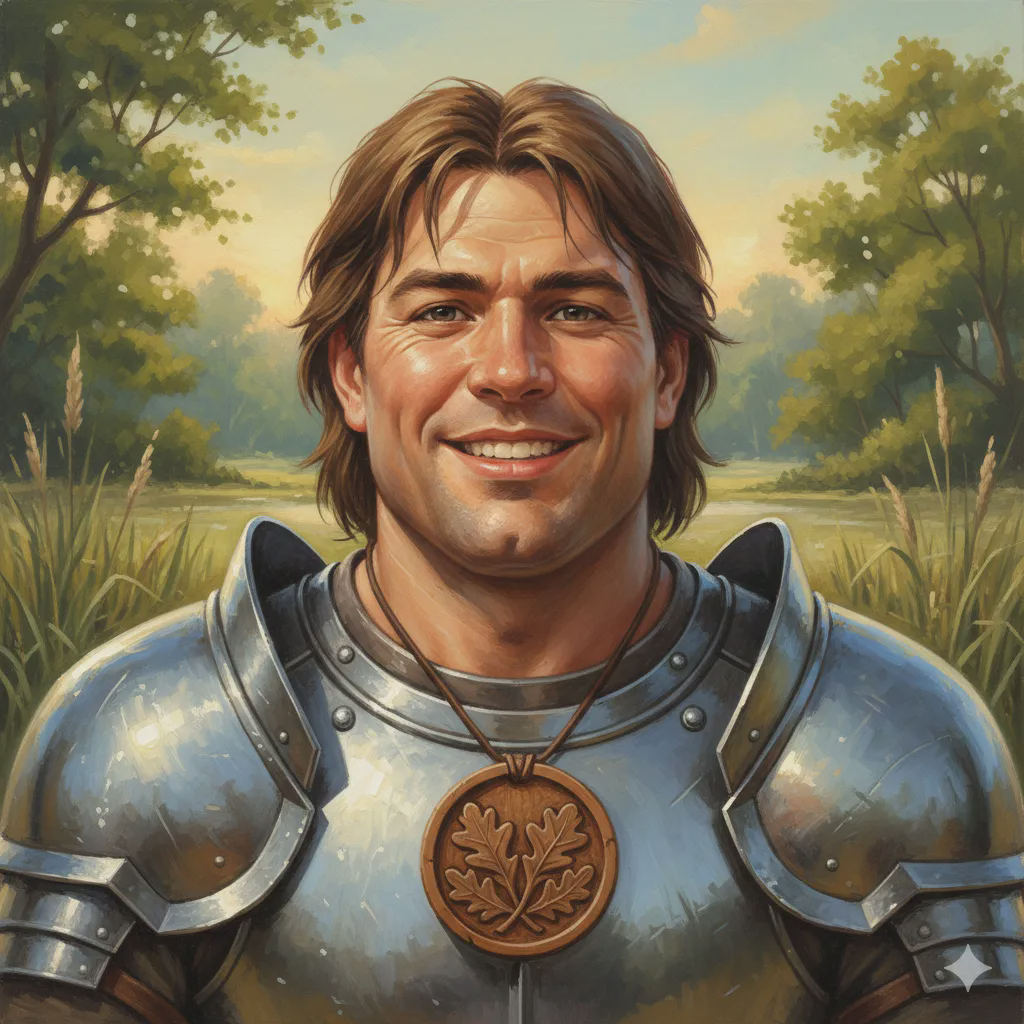
Bancroft's mother had a saying, and she came by it the hard way: more men are killed by the work than by the beast. A bull gores one man in ten years. The hayloft, the well rope, the cart that slips its chock -- those take somebody every season. It was a cart that took Bancroft's father, a loaded wagon on a hillside and the chock kicked loose, and his mother said the words over the grave and went on saying them the rest of her days, until they were worn smooth as a creek stone in her son's ear. Bancroft went down into the Barrowmaze on the fourteenth and came up out of it alive, and the whole of the danger, from first breath to last, was gravity. The dead in that place tried and tried and could not manage what a length of rope and a bad grip nearly did for free.
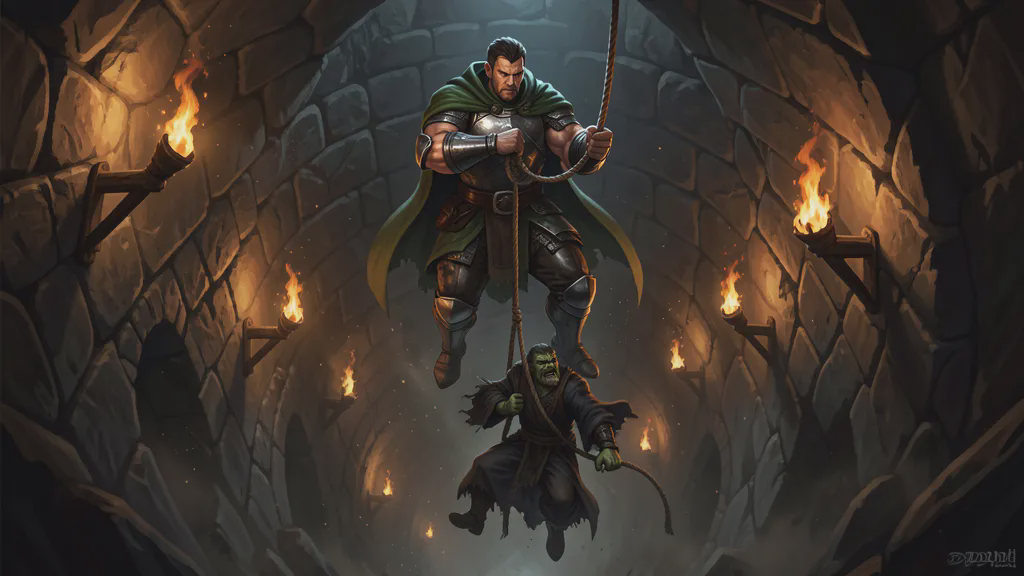
They went in the way they always go in, down the shaft at the mouth of the barrows on the block and pulley, one at a time in the harness, the others working the rope. It is honest labor and Bancroft is built for it, but it is not without teeth. Shacknub went down poorly -- the half-orc is a scholar, not a hauler, and a wizard weighs the same as a man for all his cleverness -- and somewhere in the dark of the drop he came out of the loop and fell.1 There was a bad moment where Bancroft felt the whole line jump in his hands. He set his heels and he prayed and he caught the wizard before the stone at the bottom could have him, and it cost the party the last of its luck to do it. Bancroft gave that back with a blessing, the way you pay a debt while you still remember owing it, and healed the scrapes Shacknub had already taken, and they got him down whole. A poor start. It should have been the warning.
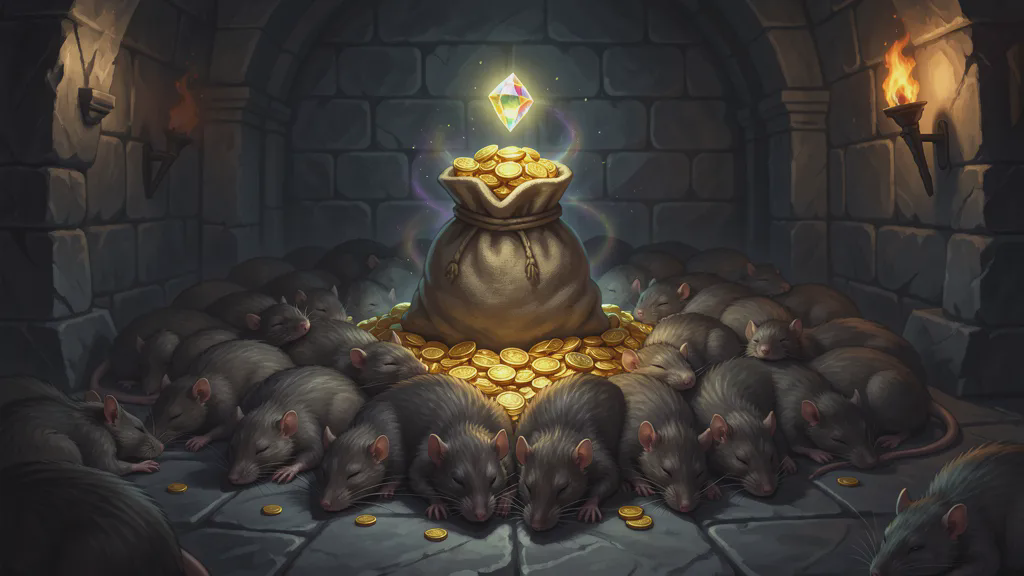
From the bottom they went south, into ground they knew, or thought they did. What they had forgotten was the rats. There is a room down there they had walked past before, and behind its door a whole nest of the things, and when Anister put the door open they were as surprised as the party was.2 Anister and Irulan did not wait to think about it. They went in and each of them killed a rat in the first breath, quick as barn cats. Bancroft held his hand. It is a thing he has been feeling his way toward of late, more a principle than a settled rule: that a man can mean to live through dangerous places and still owe the natural world some respect. If a creature comes at him to kill him, that settles it one way. If he is hungry and it is meat, that settles it another. But to haul a door open and set straightaway to slaughtering a den of rats for the crime of being rats -- that sat wrong with him, and he would not do it while there was any other road. So he stood his ground and put up a guard of faith and waited to see whether the swarm would make the choice for him.
It was a large swarm. It might have made the choice. But Shacknub, who had been no use at all on the rope, proved his worth on the floor: he spoke his sleep over the whole seething mass of them and they went down where they stood, a room full of rats breathing slow. That was the answer to the whole knot of it -- nobody's blood spilled, the rats' or the party's, and Bancroft was glad enough of the wizard to forgive him the rope. In the quiet after, Anister stepped over the sleeping ones and lifted a sack of coin somebody had lost or hidden in there long ago. Bancroft does not much like taking from a place while its keepers sleep, but the rats were not the owners of the coin, and a party has to eat when it climbs back into the daylight.
They searched on, and here Bancroft's patience got a test that had nothing to do with the dead. There was a room with footprints in the dust, going and coming, and Bancroft knew it well, because he and Irulan had stood in it once before and gone over every foot of it and turned up not one thing worth the bending. Anister had not been along that time. And Anister does not take another man's word that a room is empty. He wanted it searched. Bancroft told him it had been searched -- told him twice -- and Irulan set her back against the wall and folded her arms and let her face do the rest of the talking. Anister searched it anyway, on his hands and knees, while Bancroft stood there listening to his own voice climb toward complaint and Irulan sighed loud enough to be heard in Helix.3 They found nothing. They found the very same nothing as before. Bancroft has made his peace with the long empty looking that is most of dungeoneering -- but he would sooner do his peace-making in a room he has not already emptied with his own two hands.
Then they came to the question of the pudding. There is territory down there they have kept clear of, on account of a thing that eats stone and steel and men without much minding the difference, and they stood at the edge of it a while, weighing whether they had the party this night to go in. They were still weighing it when the choice was taken from them. Two sapphire skeletons came on them out of the dark.4
Bancroft had faced their like before and thought he knew the shape of the fight. He was wrong, and the being wrong is the part worth telling. He called on the god and drove his will at them, and one of the two came apart on the spot, clattered down to nothing.5 For a heartbeat he thought it was that easy. Then the pile of bones stood back up. That is the cruel trick of the thing: the god's power scatters it, but the creature is quicker off the mark than Bancroft is -- it gathers itself an instant after he strikes, faster than he can follow the blow with another -- and so to destroy it in that way is to accomplish exactly nothing, over and over, for as long as a man has the faith to spend. He tried it a second time and watched the same thing happen, one turned, one held its feet, and the turned one back up before he could be glad of it. There is a particular humiliation in swinging the hammer of your god and having it do less than a good sword would.
What the turning was good for, they worked out between them, was fear. A driven-back skeleton that flees is a skeleton out of the fight for a while, even if you cannot break it for good. So they built a fight around that. Bancroft and Anister made a line across the corridor and held it; Shacknub stood behind and threw his darts of light over their shoulders; Irulan, who is worth any three of the rest of them with a blade, slid up past the line to strike and slid back before the thing could answer. On the third calling one of the two broke and ran, and they turned the whole of themselves on the one that stayed.
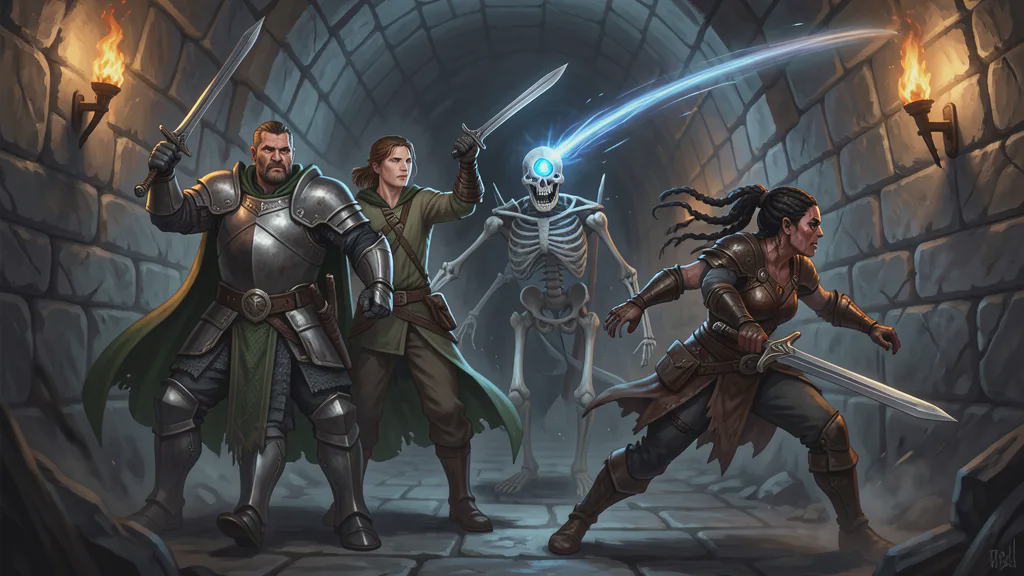
It comes down to the gem. Each of the things wears a sapphire set in its brow, plain as a third eye, and that stone is the whole of it -- break the gem and the bones are only bones. So Bancroft, thinking himself clever, set down his good elven sword to free both hands, snatched up one of the gems where a scattering had left it loose on the floor, and meant to pitch it back down the passage into the room full of sleeping rats and let the vermin and the undead sort each other out.6 He is not a thrower. The skeleton pulled itself back together before he could get the gem away, and now his sword was lying a dozen feet down the corridor with a fight between him and it, and he was standing there empty-handed and feeling the fool. Anister lent him a blade. Bancroft wreathed it in cleansing fire -- that much of the god's work does bite on the dead -- and got back in the line, and they did it the plain way after that. No cleverness. Shacknub waited with his light ready for the gem to show itself, the line held, Irulan struck where the striking was good. And the gem broke.
It is worth saying plainly what that was, because it had never happened before. They have met these skeletons more than once, and every time it went the same: scatter the bones, watch them rise, scatter them again, and come away having killed nothing at all. Never once had any of them put the gem down for good before it could gather itself back up. This was the first. When the sapphire cracked in its brow and the thing went to a loose heap of bone and did not move again, there was a beat of pure silence, and then the whole party was making noise -- Anister crowing, Irulan grinning like a wolf, and even Bancroft, who is not built for whooping, felt the grin take his own face. They had finally killed one. Then somebody remembered the little heap of sapphire shards was bright as a broken window and worth good money, and they got down on their knees and gathered it up.
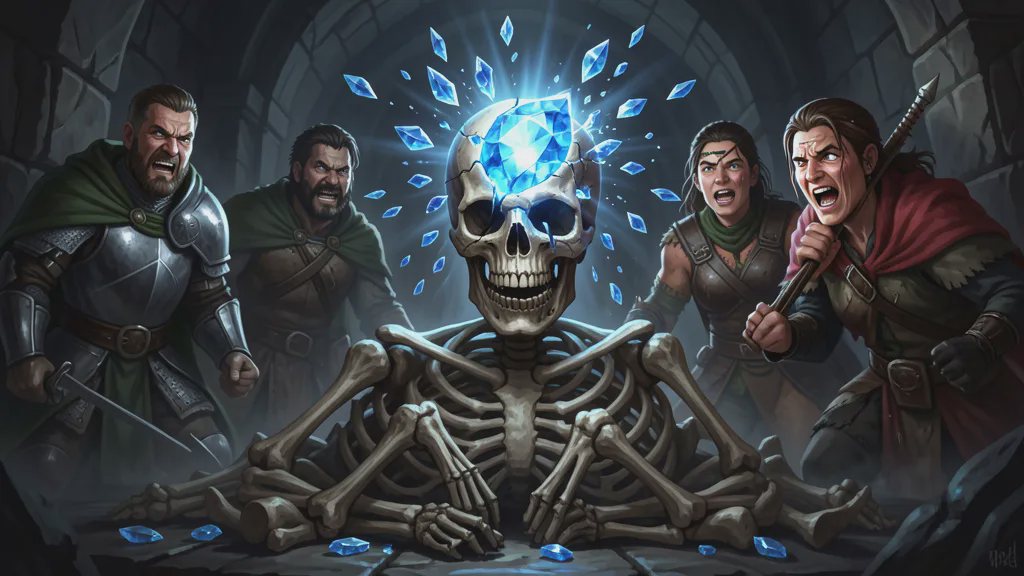
They were still on their knees gathering when the second one came back.7 It had run, and its running had run out, and it wanted the rest of the fight. They gave it the same treatment, and it was harder work than the first -- Irulan took a few wounds off it before it was done, nothing that would not mend, and a blessing came off wrong in Bancroft's hands at the worst of it, a prayer that guttered out instead of catching.8 Shacknub's magic failed on the killing gem when they needed it most. In the end the thing came apart under a blow from Irulan and a blow from Bancroft and -- of all the absurd sights of a long strange season -- Anister standing off in the passage putting foebane arrows one after another into a gemstone the size of a plum until it broke.9 A ranger shooting a jewel. Bancroft laughed about it later. At the time nobody had the breath.
And that was the dungeon done, so far as the dungeon meant to trouble them. They had coin, they had a sack of sapphire, they had the wit to know when to leave. So they went back to the rope, and the rope nearly killed every one of them.
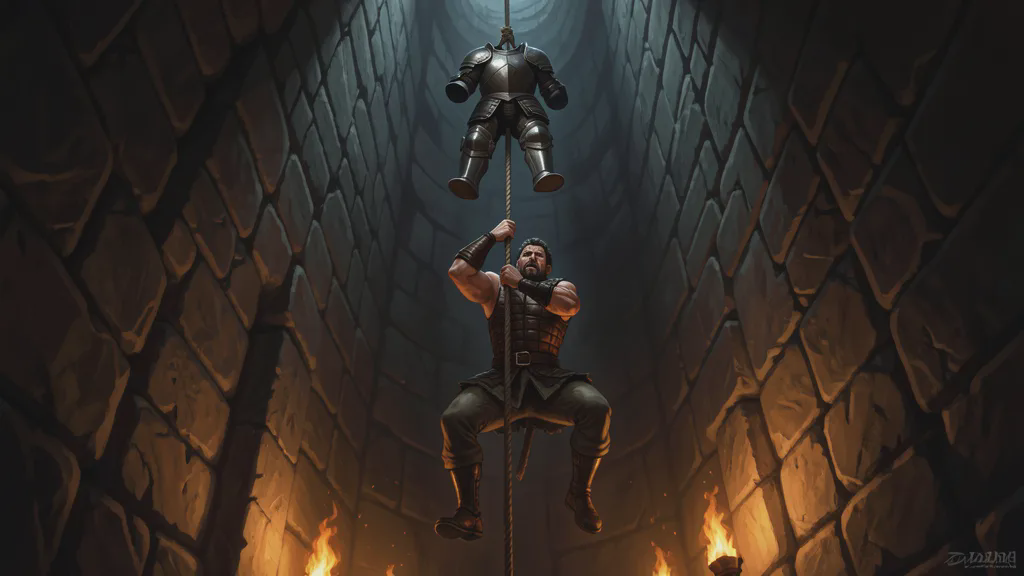
It should not have. It is the same climb they came down, only backwards. But a man going up a shaft with his arms full of loot and his legs gone to water from a fight is a different creature than the one who came down fresh, and one after another they lost their grip and fell.10 Bancroft caught the wizard twice -- twice -- setting his body against the line and taking the whole jolt of a falling man through his shoulders, and caught Irulan once besides, and every catch cost him. A caught man does not fall; the man who caught him does the falling for both of them, a little, in his joints and his back and the raw skin of his hands. They spent luck the way you spend water in a drought, rerolling the worst of the slips. Anister went down the line with his salves keeping people off death's door for the crime of trying to climb a rope. And Bancroft, who had walked into two skeletons and out again without a scratch that mattered, came up out of that shaft near enough to dead -- down from hale to hanging on, and not one point of it spent on an enemy. All of it was the weight and the fall.
In the end he did the only sensible thing left, which was to quit being proud. He stood at the bottom and took off his armor -- ten long minutes of buckles in the dark, every plate of it -- and had the empty steel hauled up on its own, and then climbed the shaft as light as he ever gets, just a man and a rope and no iron trying to drag him back down to the stone. It worked. They all of them got out alive, blinking in the barrow-mouth with their sapphire and their aching arms.
Bancroft's father was right, is the thing. The beast down there tried its hardest and could not do what a bad grip did to them for nothing. The only enemy that night was gravity, and it very nearly won.
-
The session opens with the party descending the pulley shaft at the Barrowmaze entrance -- a run of Strength and Dexterity checks to work the rope and ride the harness down. Shacknub, the half-orc wizard, slips the loop mid-descent and falls; the party spends its last luck point to catch him. Bancroft heals the fall damage (Cure Wounds, one of the heals a critical) and casts Bless, which restores the spent luck point. Bancroft rolls a natural 20 on initiative for the night and is still beaten to the draw by Anister, whose Dexterity bonus carries his initiative to 22. ↩︎
-
A door opens onto a room the party had cleared before but forgotten had refilled with rats. The rats are surprised. Anister and Irulan each drop one in the first round; Bancroft, refusing to strike a natural animal before it attacks, casts Shield of Faith and stands on the defensive. It proves to be a large swarm -- resolved not by blades but by Shacknub's Sleep, which puts the whole nest down. Anister then slips in and lifts a sack of coins. ↩︎
-
The cluster of repeated Wisdom checks (Bancroft rolling poorly, 4s) is the party searching a room marked with footprints. They find nothing. ↩︎
-
While debating whether to risk the territory guarded by a gelatinous pudding, the party is found by a pair of sapphire skeletons -- undead animated by a sapphire set in the forehead. This session is the party's first-ever permanent kill of one: in prior encounters they had only ever disincorporated the skeletons (which then reconstitute), never destroying the gem before it re-formed. ↩︎
-
Turn Undead here is nearly worthless by a quirk of timing. A successful turn destroys a skeleton, but the sapphire skeletons act on initiative 19 -- immediately after Bancroft's 20 -- so a destroyed skeleton reconstitutes on its own turn a heartbeat later, before Bancroft can follow up. Bancroft makes three turn attempts over the fight (spellcasting checks 16/18, 14/23, 20/18); each time one skeleton is turned and reforms and the other saves. The only lasting value is that a fled skeleton is removed from the fight for a few rounds. On the third attempt one finally flees. ↩︎
-
The skeletons can only be permanently destroyed by breaking the sapphire set in the skeleton's brow. Bancroft drops his Elvish longsword (+4) to free his hands, grabs a loose gem, and intends to hurl it into the room of sleeping rats -- but the skeleton reconstitutes before he can throw it. His sword is now stranded down the corridor and unrecoverable mid-fight, so he borrows Anister's longsword and casts Cleansing Weapon on it (adds fire damage, extra against undead). ↩︎
-
With the first skeleton shattered -- leaving a pile of collectible sapphire shards -- the party is gathering the loot when the second skeleton (the one that fled earlier) returns to renew the fight. ↩︎
-
In the thick of the second skeleton fight Bancroft's Bless comes up a critical failure (rolled 6; 4, a fumble); he follows with a Cure Wounds. ↩︎
-
The second skeleton is tougher. Irulan takes minor wounds; Shacknub's spell fails on the killing blow to the gem. It finally falls to a strike from Irulan (who lands a crit, 27), a blow from Bancroft, and Anister emptying foebane longbow shots into the exposed gem -- including his own critical hit. ↩︎
-
The long tail of Strength and Dexterity checks (23:16 onward) is the ascent -- climbing back up the shaft they descended. Almost everyone falls at least once. Bancroft catches Shacknub twice and Irulan once, taking fall damage on each catch; the party burns luck points rerolling failed climbs, and Anister spends Salve healing to keep people from dying to the climb itself. Bancroft drops from 18 hit points to 5 -- entirely from fall damage, with none of it dealt by an enemy. He finally spends 10 minutes removing his armor, has it hauled up separately, and climbs unencumbered. Everyone gets out alive. ↩︎