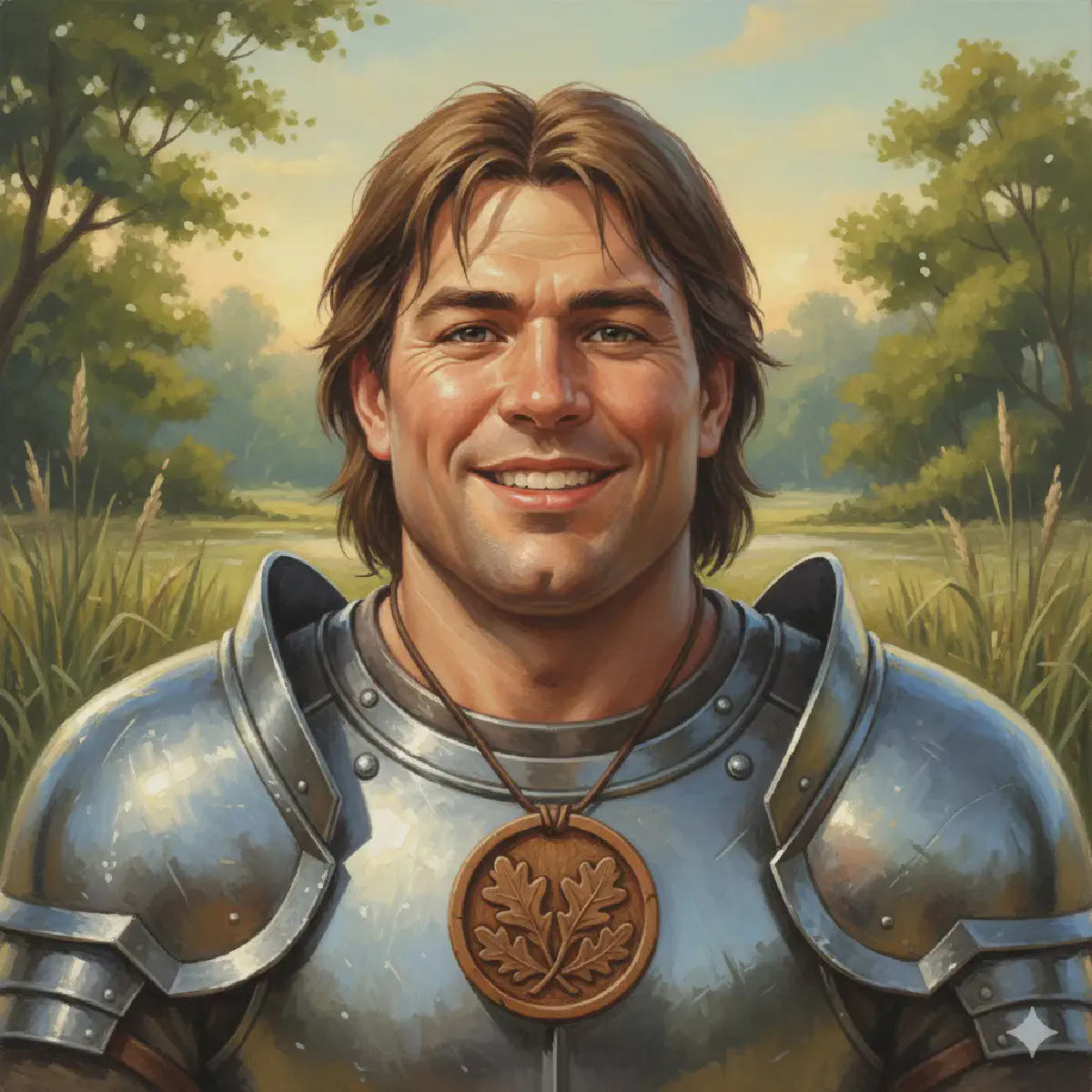
Bancroft got to Helix three days behind the others. The disease from the Huecuva had taken longer to shake than the priests of St. Ygg had promised, and by the time he walked through the gates he was light on coin, heavy on fatigue, and already behind on what mattered.
The others had been busy. They’d been digging at one of the sealed barrows — the one they’d marked on their map as D28, out on the moor — and had been at it for days between interruptions. Two of the hirelings had had enough. Rollo and the other Anister — not their Anister, but the hireling they’d picked up cheap — had looked at the work remaining and the pay being offered and decided their futures lay elsewhere. Bancroft couldn’t blame them. The barrows ate people, and smart hirelings knew when to walk.
New faces at the table. Grig was a slight man with a hand axe and leather armor who hummed the same tune over and over and wanted to know if anyone had seen gnolls. He asked it the way a man asks who’s already decided on the answer he wants. Berger was older, carried a longsword and a shield, and had scroll cases of poetry strapped across his chest like bandoliers. An armed poet. Bancroft had seen worse.
The Brazen Strumpet was still off limits. The innkeeper had a long memory and a longer grudge about the arm-wrestling damage, and Bancroft’s purse was too thin to argue the point. The Church of St. Ygg would have taken him in, but the thought of sleeping under their roof — their prayers, their rules, their particular brand of charity — sat wrong. So he walked north, past the last houses, to the statue of Herne the Hunter.
It was a good spot. Quiet. The stone figure of Herne stood with his bow drawn against the treeline, and the offerings at his feet — dried flowers, a set of antlers, bundles of herbs — smelled clean and honest. Bancroft wrapped his weatherproof cloak around himself and settled against the base of the statue and decided he’d eat what he could catch.
He couldn’t catch anything.
He’d grown up on a farm, not in the woods. Planting he understood. Harvesting he understood. Tracking something through scrub brush at dusk with a crossbow he barely knew how to aim — that was someone else’s skill, and he didn’t have it. He blundered through the undergrowth for the better part of an hour, flushing nothing, finding nothing, until he saw movement low to the ground about thirty feet out.
He shot. The bolt went wide, skipping off a root and vanishing into the dark. And the thing he’d shot at moved — not away from him, but toward him, fast, low, legs working in a horrible fluid scuttle that covered the distance before he could reload.
Giant spider. He knew it the way you know a horse kick is coming — too late to dodge, just soon enough to understand what’s about to happen.
It was faster than him. His shield was on his back because he’d had the crossbow out, and the spider found the gap like it knew it was there. One bite, quick and surgical, two points of pressure on the side of his neck. The pain was small. A pinch. Nothing.
Then the venom hit.
It started in his neck and spread outward like cold water poured down his spine. His fingers stopped answering. His legs went. He was on the ground and he couldn’t move, couldn’t shout, couldn’t do anything but lie there with his eyes open while the spider began to wrap him in silk.

Bancroft lies paralyzed on the forest floor as a giant spider looms over him, wrapping him in silk
He saw everything.
The spider wrapped him in webbing — efficient, practiced, the way a farmer wraps a bale — and dragged him backward into the trees. The Black Forest. He’d heard the warnings. Irulan had told them, more than once, that the forest was death. He’d nodded and filed it under things that happened to other people.
The tree was enormous. Old growth, thick-trunked, branches reaching out over a clearing that stank of silk and rot. Web sacks hung from every limb — dozens of them, human-shaped, motionless. Some were fresh. Some had been there long enough that the shapes inside had stopped looking like people. Bancroft was hauled up and added to the collection, another sack on the line, and the spider that had brought him settled in to feed.
He felt it starting. Something drawing out of him — not blood, or not only blood, but something deeper. Warmth. Weight. The substance of being alive. His body tried to fight the venom and couldn’t. The rot from the Huecuva was barely out of his blood. The priests of St. Ygg had cured the disease, but the weeks of it had hollowed him out, and what was left wasn’t enough to resist what the spider was doing to him now.
He prayed.
Not the formal prayers — the ones with structure and words and the weight of ritual behind them. Just the raw thing underneath. Sylvanus. I’m dying. Help me.
Nothing.
He tried again, harder, the way he’d tried in the barrow when the Huecuva came and the god had refused to turn them. The same silence. The same empty well. But this time, in the space between the prayer and the nothing, he felt something — not an answer but a presence, vast and indifferent, the way a forest is indifferent to a single falling tree. And he understood.
The spider was natural. It was doing what spiders did. Sylvanus wouldn’t strike down one of his own creatures to save a man who’d walked into its territory and shot at it with a crossbow. The forest didn’t owe him anything.
Bancroft lay in his web sack and felt himself going and thought about that. Fair enough. The spider had a right to eat. But Bancroft had a right to argue.
My friends tracked down a priest of Nergul. They killed him. Whatever he was doing in your barrows, in your ground, with your dead — they stopped it. And I am hanging in this tree because I would not take charity from Ygg. I walked out of his church and I slept under your statue because I thought you were worth the inconvenience. If you let me die here, that’s your business. But you should know why I came.
The presence shifted. Not warmth — nothing so generous. More like a reconsideration. The way a farmer looks at a draft horse that’s gone lame and decides it’s worth one more season.

A massive tree in the Black Forest draped with web-wrapped victims, spiders lurking in the canopy
Between the prayer and what came after, there was a space.
He was floating. On his back, in water, in the dark. Not cold — not anything, really. The water held him the way a hand holds a sleeping child, and he drifted. A lazy current carried him, bumping gently against things he couldn’t see. Somewhere above or around him, a faint sound — a tinkling, like a small bell struck once and left to ring.
Then a voice. Not his. Not anyone he knew. Alarmed, flustered, the way someone sounds when they find a thing where it shouldn’t be.
Oh no. You’re not supposed to be here. No, no, no — this will never do.
Something long — a foot, a stick, a shepherd’s crook — pushed against his side and dragged him toward what might have been a shore. The voice kept muttering. The water got shallow. And then a scream — distant, animal, the sound of something large and terrified crashing through the undergrowth — ripped him back into his body and into pain.
The spider had pulled away. Something out in the forest had flushed prey toward the clearing — something large enough to be worth abandoning a half-finished meal. Bancroft didn’t know what it was. He didn’t think it was coincidence.
He was alone in his web sack with feeling returning to his hands in the worst possible way. He found his dagger. Cut the silk strand by strand, fingers barely working, each motion costing something he couldn’t afford. He fell. Hit the ground. Crawled. Found darkness that didn’t have spiders in it, curled up in it, and stopped.
But the price was real. He could feel it — something taken permanently. A capacity reduced, a ceiling lowered. Two puncture wounds on his neck leaked green where the fangs had been, and the skin around them had already started to scar in a way that would never fully heal. He looked like he’d been bitten by a vampire. He hadn’t been that lucky.
Morning. Light through branches. His body was a single bruise that had learned to breathe.
He’d made it back to Herne’s statue somehow — whether he’d walked or crawled, he couldn’t say. The stone hunter still stood with his bow drawn, indifferent to the wreckage at his feet. But there was something new at the base of the altar. Food. Nuts, berries, a strip of dried meat laid out on a broad leaf. Simple trail rations, the kind any woodsman might carry.
It was wrong for an offering. People left flowers for Herne, or herbs, or the antlers of a kill. Not food. Not the kind of thing a hungry man would need the morning after nearly dying.
Bancroft looked around. No one. The treeline was empty, the path back to town undisturbed. He tried to read the thing for what it was — a gift from the god, or someone’s abandoned lunch, or a trap with poison he wouldn’t survive twice — and couldn’t make sense of it. His mind was mud.
He ate. It tasted like the best meal he’d ever had, and the fog in his head lifted, and the grinding ache in his bones retreated to something he could carry. He stood. He walked south toward Helix, slowly, filthy, covered in dried webbing and his own blood, looking like something the forest had chewed on and spat out.
Which was about right.
Irulan was the first to see him. She didn’t say much — she never did when it mattered — but she looked at the puncture wounds and the webbing and the green ooze drying on his collar and she walked into the Brazen Strumpet and put a jade gemstone the size of a walnut on the innkeeper’s counter.
“He’s coming back in,” she said.
The innkeeper looked at the jade. Looked at Bancroft, who was standing in the doorway like a scarecrow that had given up. Pocketed the stone.
“He won the arm-wrestling competition,” Irulan added. “Consider it reparation.”
“I wish you’d come sooner,” the innkeeper said, already envisioning what forty-five gold pieces of jade could do for the common room. “This’ll do nicely for the expansion.”
Bancroft tried to say thank you. What came out was a croak that might have been words in a language that included consonants. He sounded like he’d been gargling gravel.
“No more camping,” Irulan said. “No more spiders.”
He nodded. That much he could manage.
Over drinks he couldn’t taste, the tavern talk turned to rumors. Someone had heard of a powerful evil warrior — a real one, leveled and dangerous — who used the Barrowmaze itself as a hideout. Him and his band. Something to add to the list of things down there that wanted to kill them. The list was getting long.
The next morning they went back to the barrows. Bancroft was on watch — he wasn’t fit for digging, and nobody argued the point. Riyou watched with him while Grig and Berger and Irulan worked the shovels at the barrow. The entrance was taking shape now, the outlines of stonework emerging from the packed earth.
The Boon Companions found them again.
Sly the Medium walked up with his hands on his hips and a smile that said he’d expected to find them exactly here. He had fighters at his flanks and porters behind him carrying empty chests — optimistic packing for wherever they were headed next.
“Well, I figured you’d be here,” he said. “Can’t wait to see what’s in there. We’ll get sloppy seconds on this one. I’m okay with it.”
Riyou tried to send him to another entrance — the one where the things they’d accidentally released were still loose. Anister played along with a joke about friendly harpies. Sly saw through both of them without breaking stride.
“Oldest trick in the book,” he said. “I’ve done it myself. Leading people to certain death.”
He mentioned that someone had gone and made a mess of that same entrance — opened a door that shouldn’t have been opened, let something out that was now making the whole area unusable. The party kept their faces neutral. Bancroft thought about the door and the things behind it and said nothing.
Sly gave them finger crossbows — the adventurer’s equivalent of a wink — and left with his people. Bancroft watched him go and had the distinct feeling that Sly the Medium was filing every word of this conversation away for later.
Professional rivals. Not enemies. Not yet.
The digging continued. Another hour. The stonework grew clearer — a real entrance, sealed and waiting, close enough to touch if they could clear another few feet of earth.
Then Bancroft saw them.
Nine figures, coming across the moor from the east. Not the Boon Companions — these moved differently. Spread out. Quiet. The way people move when they’ve already decided what they’re going to do and conversation isn’t part of it.
Bandits. Nine of them. They’d seen the shovels, the dig site, the small party bent over the work, and they wanted what was underneath.
Bancroft called the warning. Irulan dropped her shovel. Grig’s hand went to his axe. Berger set down a scroll case and drew his sword with the careful deliberation of a man who understood that the next few minutes were going to be very different from poetry.
Nine against six, and the six had been digging all morning.
The bandits didn’t slow down.

Adventurers at a barrow dig site on an open moor as armed bandits approach across the grassland